A woman prays the rosary. / siam.pukkato/Shutterstock.
Denver Newsroom, Nov 24, 2021 / 16:17 pm (CNA).
A new study by the Pew Research Center found that few Americans blame God for suffering in the world. Instead, Americans are more likely to blame suffering on random chance, the actions of others, or society at large.
The survey included questions about both religious or spiritual belief, and the meaning of suffering. Respondents who expressed a belief in God, or a higher power, were subsequently asked if they blame God when bad things happen in the world.
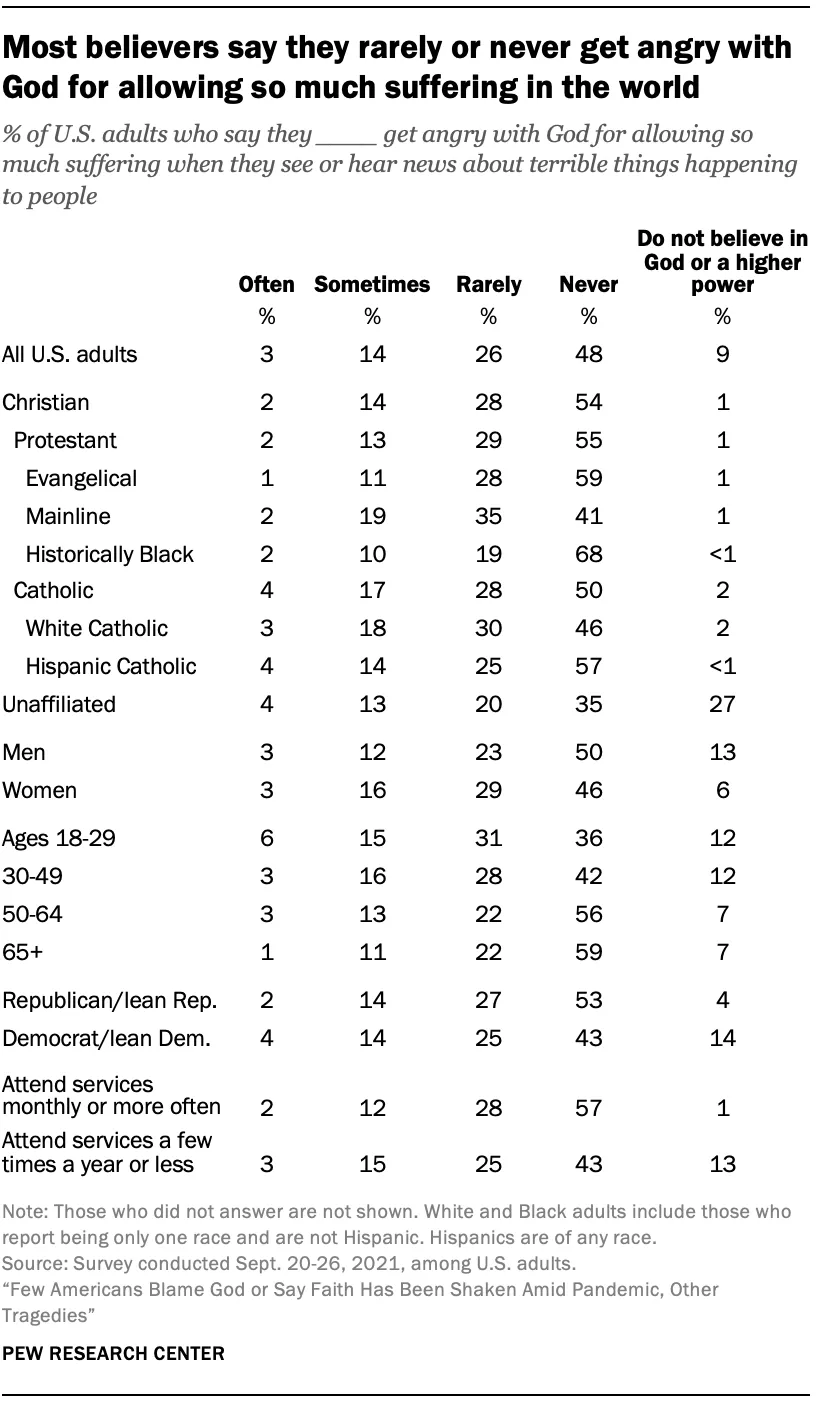
Nearly 75% of respondents who expressed a belief in God, or a higher power, said they “rarely” or “never” feel angry with God in the face of suffering. Protestants in the historically Black tradition and older Americans were more likely to say this, the survey found.
Pew Research Center.
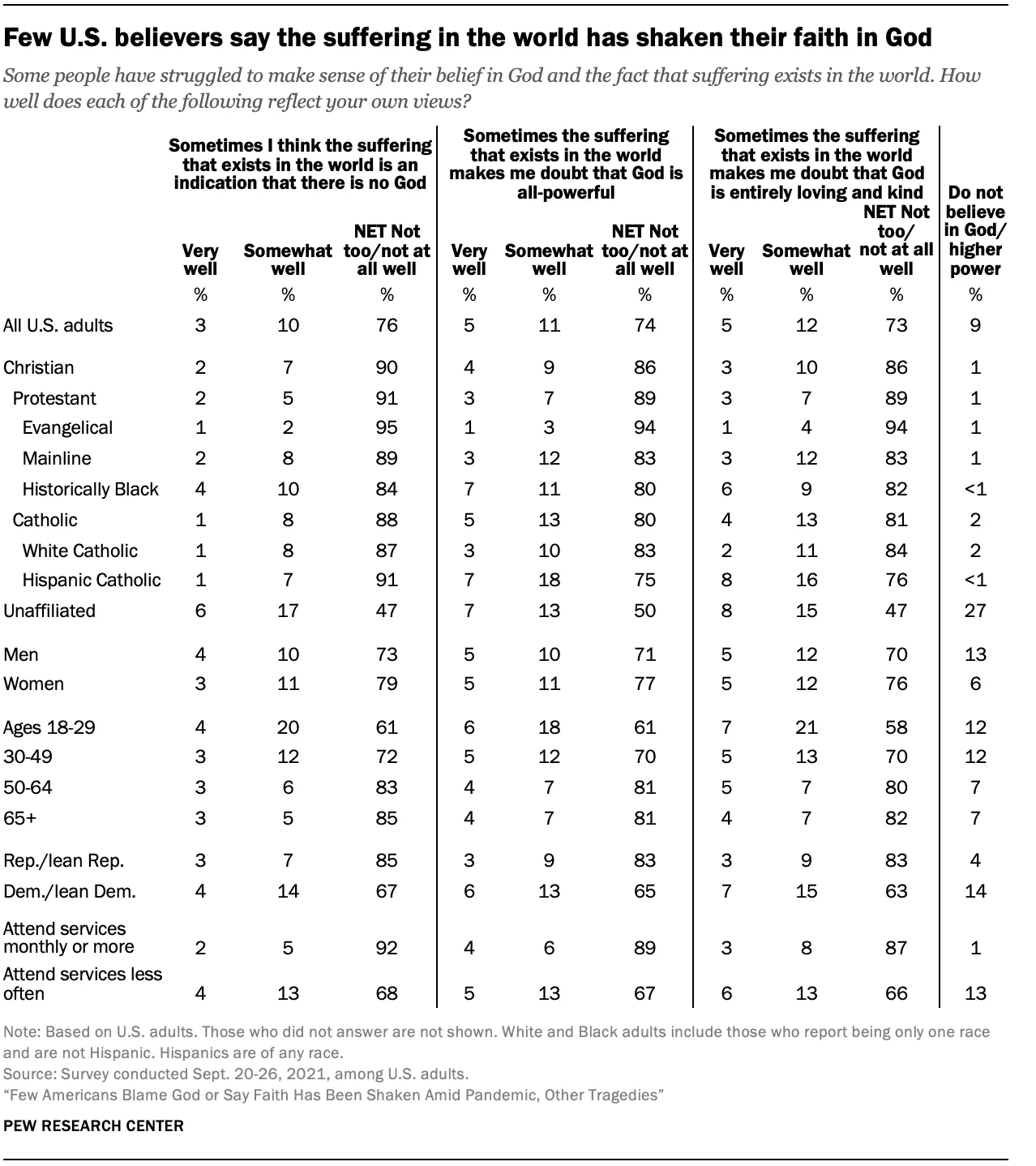
Fewer than 15% of those same respondents said suffering in the world makes them doubt God’s existence, omnipotence, or kindness. The survey found that doubt as a response to suffering was somewhat more common among young adults, Democrats, and religiously unaffiliated Americans.
Pew Research Center.
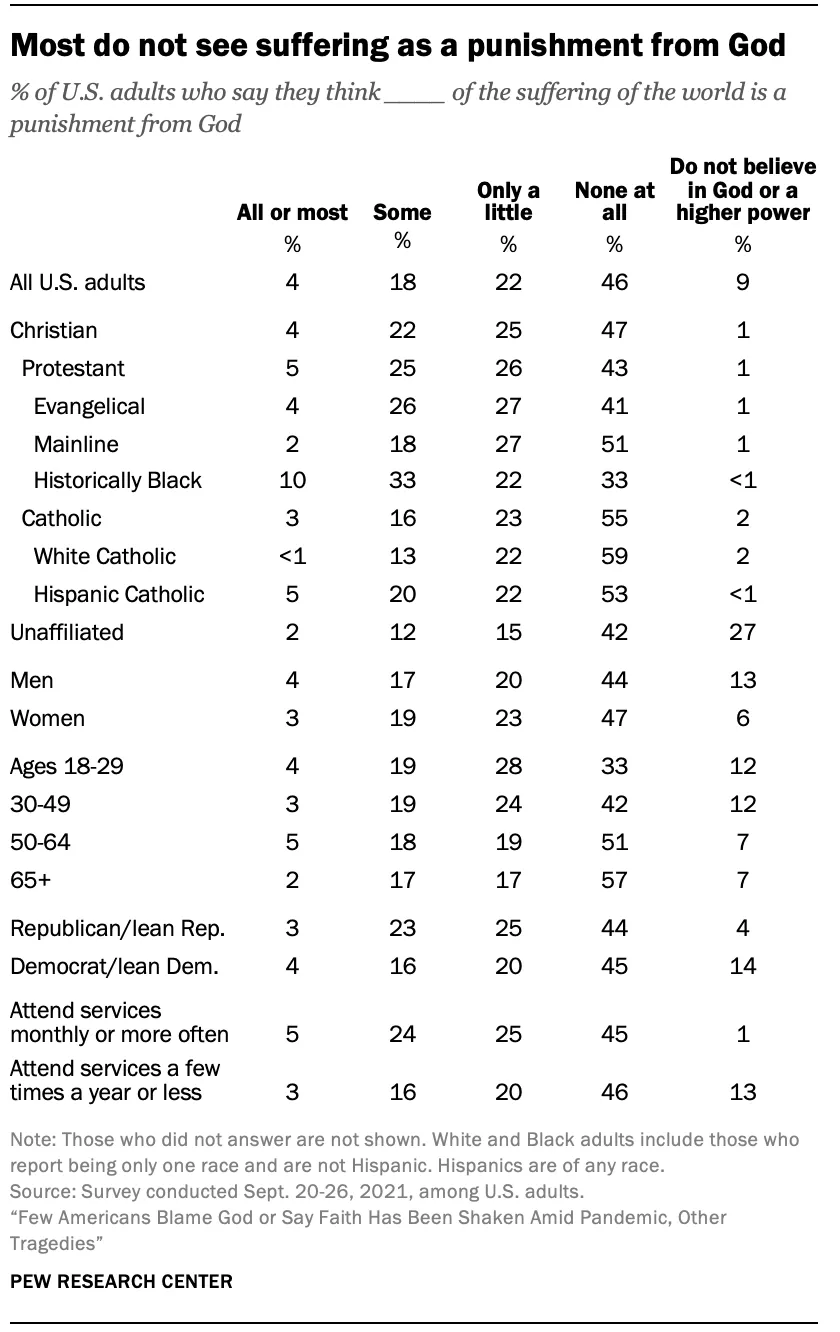
Similarly, few of those same respondents said they believe suffering in the world is a punishment from God. Only 4% believe “all” or “most” suffering is a punishment from God, while 18% said “some,” and 22% said “only a little” is a punishment from God, the survey found.
Pew Research Center.
The survey found that more than 70% of all respondents believe suffering in the world is mostly a consequence of people’s own actions, while 80% of respondents who expressed a belief in God or a higher power believe suffering in the world is mostly a consequence of people’s own actions, not from God.
Slightly more than half of those respondents believe God allows human suffering as part of a larger plan, with Evangelical Protestants most likely to hold that belief.
The survey included questions ranging from beliefs about the purpose of suffering, to beliefs in the afterlife. This was reportedly the first time the Pew Research Center attempted to pose some of these philosophical questions to U.S. adults, the survey stated. Pew asked Americans to share their views both in their own words, and by selecting from a list of options.
If you value the news and views Catholic World Report provides, please consider donating to support our efforts. Your contribution will help us continue to make CWR available to all readers worldwide for free, without a subscription. Thank you for your generosity!
Click here for more information on donating to CWR. Click here to sign up for our newsletter.
Denver Newsroom, Mar 5, 2021 / 04:28 pm (CNA).- Several actors who worked on the film “Roe v. Wade” claim they are still waiting to be paid for their work on the movie, despite shooting their scenes over two years ago.
The film’s co-director and co-producer told CNA that the payment issue is resolved on their end, and they are waiting for the actors union to pay the actors using a large deposit the filmmakers placed with the union.
“Roe v. Wade,” a film about the landmark 1973 US Supreme Court decision on abortion, premiered last weekend at the Conservative Political Action Conference.
Susan LaBrecque, a Mississippi-based actor with a small speaking role in the movie, told CNA that she has yet to be paid for her work, despite her scenes being filmed over two days in New Orleans during July 2018.
Members of the actors union, SAG-AFTRA, normally can expect their payment to arrive within 30-45 days of filming, LaBrecque said.
Because the current payments are delayed, there will be late fees applied by the union, she noted. She said she knows of several other actors in the film— all with similarly small roles— who have not gotten their paychecks.
She said to her, it feels wrong that the film premiered before everyone involved was compensated for the work they put into it.
“It feels wrong to tell [such] a moral story in a way, and have something in the background that’s not morally correct,” LaBrecque told CNA.
Cathy Allyn, co-director and producer of the movie, told CNA that they had placed a $200,000 deposit with SAG to cover any missed payments or other expenses, which is common practice in the film industry.
The missing payments were not caught until the filmmakers completed post-production accounting, at which point it was too late for them to hire a payroll company, Allyn asserted.
Allyn said she signed paperwork “a few weeks ago” to allow SAG to release their deposit to a payroll company, which will pay the actors.
She said the payment issues were likely due to “incomplete paperwork,” that she had apologized to the actors profusely, and that she and her co-producer Nick Loeb have no intention of leaving cast members “hanging.”
She said the filmmakers went through the “appropriate legal avenues” with SAG, and that COVID-19 likely contributed to the delay in the payments.
SAG did not respond by press time Friday to CNA’s request for comment, but released a statement to Los Angeles Magazine on the matter March 3.
“We were finally able to secure a release on the producer’s deposit [from] February 10. We are processing the funds with a payroll company so we can get payments out to performers as quickly as possible,” the statement reads.
“This does not cover all of the claims and we hope that the producer will fulfill its obligations and fully pay all talent,” it concluded.
LaBrecque pushed back on Allyn’s assertion that the actors know what they are owed, stating that she does not have “any idea how much the fees are, or when they will be paid.”
Actors Sherri Eakin and Brent Phillip Henry confirmed to The Hollywood Reporter that they, too, have yet to be compensated. They told THR that they have also not yet been given a payment schedule.
CNA encouraged other actors with the same problem to reach out voluntarily, but did not receive any additional reports by press time.
“Roe v. Wade” is set to be available in April on Amazon Prime and iTunes. Among its executive producers is Dr. Alveda King, Martin Luther King Jr.’s niece.
Loeb, a businessman-turned-filmmaker and actor, co-directed, co-produced, and starred in “Roe v. Wade.” He plays the part of Dr. Bernard Nathanson, a prolific abortion doctor who later converted to Christianity and became pro-life.
In a Feb. 23 interview with The Hollywood Reporter, Loeb said despite the film’s subject matter, it is not a “conservative,” “religious,” or even a “pro-life” film.
Loeb said not all the actors in the film are pro-life, but at least one of the actors— whom he declined to name— converted from pro-choice views to pro-life over the course of filmmaking.
“What we tried to do is really just lay out the facts of how Roe v. Wade came to be and how it was decided. People can take one view or another. I’ve had a lot of people who think it’s in the middle,” he commented to The Hollywood Reporter.
Still, Loeb himself is pro-life and the personal journey of Loeb’s character, Nathanson, is one of pro-life conversion.
“Why some folks may think it’s a conservative film or why it aligns with those views is because the protagonist actually converts. He starts off pro-choice and becomes pro-life through his journey. It’s a true story,” Loeb commented.
Nathanson personally performed an estimated 5,000 abortions and oversaw tens of thousands more, including one on his own pregnant girlfriend in the 1960s.
Nathanson was previously a strong proponent of legalized abortion, and has been accused of inflating statistics on illegal abortions in the U.S. In 1969, he helped to found the lobbying organization now known as NARAL Pro-Choice America.
He left the practice of abortion in the early 1970s, and became a Christian and a pro-life activist until his death in 2011.
Thomas Monaghan, founder of Domino’s Pizza, spoke to Colm Flynn on EWTN News In-Depth on June 23, 2023. / Photo credit: EWTN
Denver, Colo., Jul 6, 2023 / 12:30 pm (CNA).
Thomas Monaghan, the founder of Domino’s Pizza, sat down with EWTN News InDepth on June 23 to share how he went from living in an orphanage to becoming one of the wealthiest men in the world. He now devotes his time and money to helping young people receive a well-formed Catholic education.
Monaghan was 4 years old when his father passed away on Christmas Eve. Unable to cope with the death of her husband, his mother placed her two sons into St. Joseph’s Home for Boys, an orphanage in Jackson, Michigan.
“The orphanage was basically like a prison,” Monaghan told Colm Flynn in an interview with EWTN News In-Depth on June 23. “It was 50 boys, Polish nuns, very strict, very holy.”
One of Monaghan’s daily tasks during his time in the orphanage was to clean the small chapel. This mundane task ended up bringing him closer to the Blessed Sacrament.
“I felt I was in a special place and I, of course, knew that Jesus was in the tabernacle up there,” he said.
Despite the hardships the young boy faced in the orphanage, he managed to focus on what he would achieve once he was out of the orphanage. Monaghan shared that he was always “looking ahead.”
“I was going to do all the things I’m capable of doing and want to do and should do when I’m 18 years old and on my own,” he told Flynn.
After leaving the orphanage Monaghan joined the United States Marine Corps. Once he finished his time with the Marines, he was looking for a job and a purpose in life. That is when his brother gave him the idea to borrow a couple of hundred dollars to buy a pizzeria that was for sale in Ann Arbor, Michigan. The pizzeria was called ‘Domi-Nick’s.’
“It was a hole in the wall,” he said. “It was 500 dollars down, but became the largest pizza chain in the world.”
Monaghan went on to change the name from ‘Domi-Nick’s’ to ‘Domino’s’ and opened two other locations in Michigan. Over the next two decades, he redesigned the pizza box so that it would keep the pizza hotter for longer. He decided to focus on takeaway and delivery, instead of dining in, and he designed the conveyor belt pizza oven to cook the pizzas faster.
However, the marketing strategy that would change the course of his life was his guarantee to customers that they would receive a hot pizza in 30 minutes or get their money back.
Thomas Monaghan, founder of Domino’s Pizza, speaks with Mother Angelica at EWTN. Photo credit: EWTN
“Finally, after 20 years, I got everything worked out,” Monaghan told Flynn, “I started in 1960. This was 1980 and we took off like a rocket. We were the fastest-growing restaurant chain in the history of the world. In 1985 we opened 954 stores. More than anybody ever did in one year.”
“In 1980 we had about 300 stores, in about 1986 or seven we had about 5,000,” Monaghan added.
As the business grew exponentially, Monaghan shared that he began to lose sight of what was truly important and was distracted by material possessions.
“I wasn’t as ready for it as I thought I was,” he admitted. “I was going to Mass every day, practicing my faith, reading a lot of spiritual books, and I thought ‘I can handle it, I can handle it,’ but I got into the toys; I justified the yachts, the airplanes.”
Monaghan was once quoted saying, “My life had become a high-speed train going down the tracks, but was about to become a train wreck.”
It wasn’t until he read a book from C.S. Lewis that Monaghan realized he was only chasing material goods in order to prove to others that he was successful in life.
“C.S. Lewis said that the reason that you aim so high and want so much, it’s not what you want, it’s what you want is more than other people, sell more pieces than anybody else, have more money than anyone, and I thought, ‘that’s not what I want to be,’” he shared.
In 1988, Monaghan sold Domino’s Pizza for a reported one billion dollars. With that money, he went on to build a church and Ave Maria University. In addition to the church and university, he built an entire town called Ave Maria, where young Catholics could study, live their faith with their families, and grow in community.
“I want to be a beacon for Catholic higher education. Show that orthodoxy sells,” he said.
Today, there are about 33,000 people living in the town of Ave Maria. The area has its own neighborhoods, restaurants, bars, parks, and the church, which is at the center of the town. The university has over 1,200 students who study a range of subjects from economics and business to biochemistry and physics.
Monaghan hopes that every student comes out “being a well-formed Catholic” and wants “to teach courses that the Church needs the most.”
“When I get to the pearly gates — God’s been very good to me — I want to be able to say, ‘I used what you gave me well,’” he said.
Since the filming of the interview, Monaghan’s wife of more than 60 years, Marjorie Monaghan, died. She passed away at home surrounded by loved ones on July 3. The couple has four daughters, ten grandchildren, and six great-grandchildren.
The entire interview on EWTN News In-Depth can be viewed below.
Leave a Reply
