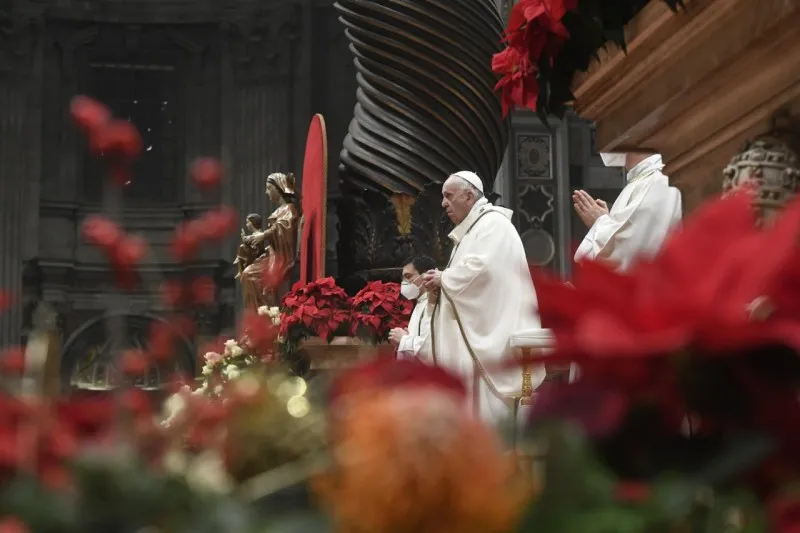
 Pope Francis offers Christmas Mass in St. Peter’s Basilica on Dec. 24, 2021 / Vatican Media
Vatican City, Dec 24, 2021 / 14:00 pm (CNA).
Below is the full text of Pope Francis’ homily for the Solemnity of the Nativity of the Lord, delivered Dec. 24, 2021 in St. Peter’s Basilica.
In the darkness, a light shines. An angel appears, the glory of the Lord shines around the shepherds and finally the message awaited for centuries is heard: “To you is born this day a Savior, who is Christ the Lord” (Lk 2:11). The angel goes on to say something surprising. He tells the shepherds how to find the God who has come down to earth: “This will be a sign for you: you will find a child wrapped in swaddling clothes, and lying in a manger” (v. 12). That is the sign: a child, a baby lying in the dire poverty of a manger. No more bright lights or choirs of angels. Only a child. Nothing else, even as Isaiah had foretold: “unto us a child is born” (Is 9:6).
The Gospel emphasizes this contrast. It relates the birth of Jesus beginning with Caesar Augustus, who orders the census of the whole world: it presents the first Emperor in all his grandeur. Yet immediately thereafter it brings us to Bethlehem, where there is no grandeur at all: just a poor child wrapped in swaddling clothes, with shepherds standing by. That is where God is, in littleness. This is the message: God does not rise up in grandeur, but lowers himself into littleness. Littleness is the path that he chose to draw near to us, to touch our hearts, to save us and to bring us back to what really matters.
Brothers and sisters, standing before the crib, we contemplate what is central, beyond all the lights and decorations, which are beautiful. We contemplate the child. In his littleness, God is completely present. Let us acknowledge this: “Baby Jesus, you are God, the God who becomes a child”. Let us be amazed by this scandalous truth. The One who embraces the universe needs to be held in another’s arms. The One who created the sun needs to be warmed. Tenderness incarnate needs to be coddled. Infinite love has a miniscule heart that beats softly. The eternal Word is an “infant”, a speechless child. The Bread of life needs to be nourished. The Creator of the world has no home. Today, all is turned upside down: God comes into the world in littleness. His grandeur appears in littleness.
Let us ask ourselves: can we accept God’s way of doing things? This is the challenge of Christmas: God reveals himself, but men and women fail to understand. He makes himself little in the eyes of the world, while we continue to seek grandeur in the eyes of the world, perhaps even in his name. God lowers himself and we try to become great. The Most High goes in search of shepherds, the unseen in our midst, and we look for visibility, to be seen. Jesus is born in order to serve, and we spend a lifetime pursuing success. God does not seek power and might; he asks for tender love and interior littleness.
This is what we should ask Jesus for at Christmas: the grace of littleness. “Lord, teach us to love littleness. Help us to understand that littleness is the way to authentic greatness”. What does it mean, concretely, to accept littleness? In the first place, it means to believe that God desires to come into the little things of our life; he wants to inhabit our daily lives, the things we do each day at home, in our families, at school and in the workplace. Amid our ordinary lived experience, he wants to do extraordinary things. His is a message of immense hope. Jesus asks us to rediscover and value the little things in life. If he is present there, what else do we need? Let us stop pining for a grandeur that is not ours to have. Let us put aside our complaints and our gloomy faces, and the greed that never satisfies! The littleness, the wonder at that small child – this is the message.
Yet there is more. Jesus does not want to come merely in the little things of our lives, but also in our own littleness: in our experience of feeling weak, frail, inadequate, perhaps even “messed up”. Dear sister or brother, if, as in Bethlehem, the darkness of night overwhelms you, if you feel surrounded by cold indifference, if the hurt you carry inside cries out, “You are of little account; you are worthless; you will never be loved the way you want”, tonight, if you hear this, God answers back. Tonight he tells you: “I love you just as you are. Your littleness does not frighten me, your failings do not trouble me. I became little for your sake. To be your God, I became your brother. Dear brother, dear sister, don’t be afraid of me. Find in me your measure of greatness. I am close to you, and one thing only do I ask: trust me and open your heart to me”.
To accept littleness means something else too. It means embracing Jesus in the little ones of today. Loving him, that is, in the least of our brothers and sisters. Serving him in the poor, those most like Jesus who was born in poverty. It is in them that he wants to be honored. On this night of love, may we have only one fear: that of offending God’s love, hurting him by despising the poor with our indifference. Jesus loves them dearly, and one day they will welcome us to heaven. A poet once wrote: “Who has not found the Heaven – below – Will fail of it above” (E. DICKINSON, Poems, P96-17). Let us not lose sight of heaven; let us care for Jesus now, caressing him in the needy, because in them he makes himself known.
We gaze once again at the crib, and we see that at his birth Jesus is surrounded precisely by those little ones, by the poor. It is the shepherds. They were the most simple people, and closest to the Lord. They found him because they lived in the fields, “keeping watch over their flocks by night” (Lk 2:8). They were there to work, because they were poor. They had no timetables in life; everything depended on the flock. They could not live where and how they wanted, but on the basis of the needs of the sheep they tended. That is where Jesus is born: close to them, close to the forgotten ones of the peripheries. He comes where human dignity is put to the test. He comes to ennoble the excluded and he first reveals himself to them: not to educated and important people, but to poor working people. God tonight comes to fill with dignity the austerity of labour. He reminds us of the importance of granting dignity to men and women through labour, but also of granting dignity to human labour itself, since man is its master and not its slave. On the day of Life, let us repeat: no more deaths in the workplace! And let us commit ourselves to ensuring this.
As we take one last look at the crib, in the distance, we glimpse the Magi, journeying to worship the Lord. As we look more closely, we see that all around Jesus everything comes together: not only do we see the poor, the shepherds, but also the learned and the rich, the Magi. Everything is unified when Jesus is at the center: not our ideas about Jesus, but Jesus himself, the living One.
So then, dear brothers and sisters, let us return to Bethlehem, let us return to the origins: to the essentials of faith, to our first love, to adoration and charity. Let us look at the Magi who make their pilgrim way, and as a synodal Church, a journeying Church, let us go to Bethlehem, where God is in man and man in God. There the Lord takes first place and is worshipped; there the poor have the place nearest him; there the shepherds and Magi are joined in a fraternity beyond all labels and classifications. May God enable us to be a worshipping, poor and fraternal Church. That is what is essential. Let us go back to Bethlehem.
It is good for us to go there, obedient to the Gospel of Christmas, which shows us the Holy Family, the shepherds, the Magi: all people on a journey. Brothers and sisters, let us set out, for life itself is a pilgrimage. Let us rouse ourselves, for tonight a light has been lit, a kindly light, reminding us that, in our littleness, we are beloved sons and daughters, children of the light (cf. 1 Thess 5:5). Brothers and sisters, let us rejoice together, for no one will ever extinguish this light, the light of Jesus, who tonight shines brightly in our world.
[…]






A lot of people, including the pro-aborts and LGBTQXYZ crowd, were denied the Eucharist starting about March 20, 2020 for quite some time as I recall…
I consider America magazine a protestant voice. The Jesuits are held in disrepute by many orthodox Catholics. It’s why they’re getting no vocations.
Would you take a moment to express why a “protestant voice” might not be considered? Either from scripture or church tradition if you’d prefer?
I respect your voice and would value your opinion, if you have time.
God bless you.
Regis Martin, an admirable theologian in Withholding the Eucharist couches his repudiation of America Mag’s open communion recommendation [which already exists in Malta] in a universal understanding of a non discretionary premise.
If I may, the issue goes back to Amoris Laetitia and the idea of the Eucharist as Remedy [whether it’s the ghost writer La Plata Archbishop Tucho Fernandez’ theology it’s embraced by His Holiness] for the sinner. Elsewhere, as I believe Fr A Spadaro SJ Francis’ theological consiglieri put it, “they deny them what they really need”.
It centers on what defines Remedy in context of the penitent. Does he come to the Eucharist absent of either recognition of his sin, and intent to rectify his sinful situation [the Eucharist then received with the assumption that conversion from sin doesn’t require a freely willed desire to reform and works as a form of magic]. Or, does the sinner approach the Eucharist aware, repentant of his sin prepared to receive the Eucharist as a strengthening remedy in combating the evil that afflicts him? The latter is what pontiffs and saints prior to Francis have taught.
The Sacred Heart is a sacred symbol of God’s love revealed in the gift of his real presence in the Eucharist, a love that is neither promiscuous, nor encourages promiscuity or accommodation of evil, evil that is absolutely polar to goodness. A love that requires love freely given rather than not.
You mention that the “open communion recommendation” already exists in Malta. From Malta, Cardinal Grech just happens to be the Secretary General for the ongoing diocesan and national and continental synods, and then the (“aggregated and compiled”–the Vademecum) Synod on Synodality in 2023, or 2024, or whenever.
What the cardinal portrays as a deepening discernment of intact doctrine is just as easily seen as a grey-area nuance too far–a derailment, and in Malta already a fait accompli. https://www.catholicnewsagency.com/news/250544/cardinal-grech-2023-synod-on-synodality-is-not-sociological-analysis-of-the-church
Vraiment Pierre. Tout suite un fait accompli.
Speaker of the House Nancy Pelosi and the Jesuit publication America both refrain from mentioning the view St. Paul expressed in 1 Corinthians 11:27-29.
I do not know biblical citations by chapter and verse from memory, so I used a search engine, searching for “Paul worthy reception”. This remarkable essay was in the first few hits, and has a useful quotation from Joseph Cardinal Ratzinger.
On the Worthy Reception of Holy Communion – Part One
By Msgr. Charles Pope
June 7, 2015
Excerpt:
But many today have reduced Holy Communion to a mere sign of hospitality, such that if the Church does not extend Holy Communion to all, we are considered unkind. There is often a mistaken notion about the nature of the Last Supper (and the Eucharist that proceeds from it) that lurks behind this misconception. Many years ago, Joseph Cardinal Ratzinger articulated the misunderstanding well. I summarize the description here from his Collected Works, Vol 11, Ignatius Press pp 273-274:
Nowadays [some] New Testament scholars … say that the Eucharist … is the continuation of the meals with sinners that Jesus had held … a notion with far-reaching consequences. It would mean that the Eucharist is the sinners’ banquet, where Jesus sits at the table; [that] the Eucharist is the public gesture by which we invite everyone without exception. The logic of this is expressed in a far-reaching criticism of the Church’s Eucharist, since it implies that the Eucharist cannot be conditional on anything, not depending on denomination or even on baptism. It is necessarily an open table to which all may come to encounter the universal God …
However tempting the idea may be, it contradicts what we find in the Bible. Jesus’ Last Supper was not one of those meals he held with “publicans and sinners”. He made it subject to the basic form of the Passover, which implies that the meal was held in a family setting. Thus he kept it with his new family, with the Twelve; with those whose feet he washed, whom he had prepared by his Word and by this cleansing of absolution (John 13:10) to receive a blood relationship with him, to become one body with him.
The Eucharist is not itself the sacrament of reconciliation, but in fact it presupposes that sacrament. It is the sacrament of the reconciled, to which the Lord invites all those who have become one with him; who certainly still remain weak sinners, but yet have given their hand to him and have become part of his family.
That is why, from the beginning, the Eucharist has been preceded by a discernment … (I Corinthians 11:27 ff). The Teaching of the Twelve Apostles [the Didache] is one of the oldest writings outside the New Testament, from the beginning of the Second Century, it takes up this apostolic tradition and has the priest, just before distributing the sacrament saying:”Whoever is holy, let him approach, whoever is not, let him do penance” (Didache 10).
Last sentence from Buzz Lightyear article: “If Disney continues down this anti-family path, it can expect to see its place in the American household fizzle as inauspiciously as this last installation of the “Toy Story’ franchise.” I’d love to see Disney fade, but ay caramba. Can’t the Federalist afford some editors who help young writers temper their prose.
I subscribe to First Things, and I’ll get around to reading the article, but what really irritates me is why no one seems to be bold enough to tackle, head on, the secularization of the Church itself. Much is written about theological corruption in individual cases, but not enough is written about the pervasive evilness by willful, self-conscious clerics intent on its deconstruction. A collapsing ecclesial culture gets left to “rad-trads” who are seemingly subject to universal insult and dismissal.
In an article on feeding the hunger in our souls, CNA, brought to our attention Pope Francis’ beautiful reflection on the meaning of communion.
“We can evaluate our Eucharistic Adoration when we take care of our neighbor like Jesus does,” the pope said Sunday before the recitation of the Angelus at St. Peter’s Square in Rome.
“There is hunger for food around us, but also for companionship; there is hunger for consolation, friendship, good humor; there is hunger for attention, there is hunger to be evangelized. We find this in the Eucharistic Bread — the attention of Christ to our needs and the invitation to do the same toward those who are beside us. We need to eat and feed others.”
Yes, communion is about receiving our Lord and then sharing him, his message and love with others. This would include lost souls. Otherwise, the ritual of receiving communion would be a meaningless one.