Spanish pilgrims at World Youth Day 2023 in Lisbon, Portugal, July 31, 2023. / Credit: Duarte Mourão Nunes/Flickr JMJ Lisboa 2023
ACI Prensa Staff, Aug 1, 2023 / 16:00 pm (CNA).
Of all the young people from countries participating in World Youth Day 2023 in Lisbon, Portugal, those from Spain are the most numerous. At least 75,000 of them will participate in the event that began Aug. 1 — a high number of young people from an increasingly secularized country.
During the days prior to the start of this long-awaited event, the presence of Spanish youth was noticed throughout the streets of the Portuguese capital and its surroundings, a witness that the faith is still alive in Spain despite the decline in the practice of religion.
At a July 31 press conference in Lisbon, Cardinal Juan José Omella, archbishop of Barcelona and president of the Spanish Bishops’ Conference, told ACI Prensa, CNA’s Spanish-language news partner, that sometimes “the falling tree makes more noise than the green shoots rising up.”
“And this is a sign that there are a lot of green shoots that are growing and that it’s the future. That’s why we live with hope, and a missionary and apostle never shrinks in the face of difficulty but rather grows with the small hope of a green shoot and not of 20 falling trees,” he stressed.
For Omella, “the secularized world is an exciting world for an apostle and a missionary.”
Also participating in the press conference were Auxiliary Bishop Arturo Ros of Valencia, Spain, who is the director of the Spanish Bishops’ Conference’s Subcommittee for Youth, and Father Raúl Tinajero, a priest of the Diocese of Toledo in Spain, who both reflected on the value that this World Youth Day has for young Catholics.
Speaking to ACI Prensa, Ros remarked that the high turnout is a sign of hope. “We affirm with this that we are alive, we must continue sowing so that there is a harvest, so that there is fruit; we are alive, and not in order to fight but to sow and walk.”
“It’s true that there are some realities that we contemplate with great concern, but for example this servant has joyfully had to administer confirmation on an ongoing basis in my diocese. The groups have not decreased; you see they’re happy, they get excited, they live it with intensity,” he noted.
Ros assured that “this is a sign that we are alive and that there is hope,” and he hopes to achieve a better future, “where reconciliation, forgiveness, fraternity, and the purity or beauty of the Gospel reign, about which Pope Francis continually speaks to us.”
“These data are life, and they are hope, a firm and sure hope that they give us with their presence and their commitments for the future,” he highlighted.
Tinajero pointed out that the COVID-19 pandemic “affected us in every respect; we were afraid to reactivate youth ministry, which is always alive — there’s not a time when there isn’t an initiative.”
The priest of the Diocese of Toledo assured that “we are on a path of hope” where young people “are wanting to respond to their deep desire for happiness, and we are here to try to show them that God can answer that desire.”
This story was first published by ACI Prensa, CNA’s Spanish-language news partner. It has been translated and adapted by CNA.
If you value the news and views Catholic World Report provides, please consider donating to support our efforts. Your contribution will help us continue to make CWR available to all readers worldwide for free, without a subscription. Thank you for your generosity!
Click here for more information on donating to CWR. Click here to sign up for our newsletter.
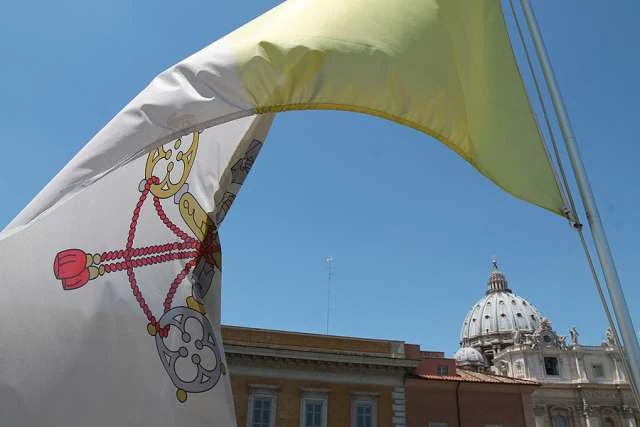
Vatican City flag waiving over St. Peter’s dome – Bohumil Petrik / CNA
Rome Newsroom, May 20, 2021 / 05:30 am (CNA).
The Vatican’s Council for the Economy faces a “huge task” in its efforts to quickly bring up the Holy See’s accounting and financial transparency to international standards, according to one of its lay members.
“We are very much focused on getting those basic standards in place and making sure the information that is in front of the pope when he makes decisions is thorough, complete, and fair. And we’re not in that situation yet,” Council for the Economy member Ruth Kelly told EWTN News.
Kelly, who was Education Secretary under British Prime Minister Tony Blair and later worked for HSBC Global Asset Management, is one of seven lay people on the Vatican council overseeing the administrative and financial structures and activities of the Roman Curia, institutions of the Holy See, and Vatican City State.
The lay members work together with eight cardinals to set the budget for the Holy See’s entities and raise the level of financial transparency — something which Kelly said can pose unique challenges.
“For example, the historic legacy is very, very difficult to tackle if you take the example of, say … a place of residence through tradition in a particular part of the Vatican, or Rome, or somewhere in the world. It may be the case that no one has ever had it valued, or really thought about who legally owned it, because through customs and tradition it was obvious to what use it should be put,” she said.
“The Holy See cannot yet account for all of the investment properties that it owns specifically around Rome and in Italy. And there’s a huge task to go through to make sure it identifies properly the ownership of each — whether it’s owned by a diocese, whether it’s owned by the Vatican, whether it’s owned by a parish, or somebody else — and then to valuate it to make sure that it’s properly accounted for in the balance sheets.”
“So that’s one real area where the Holy See needs to be moved quickly up to date.”
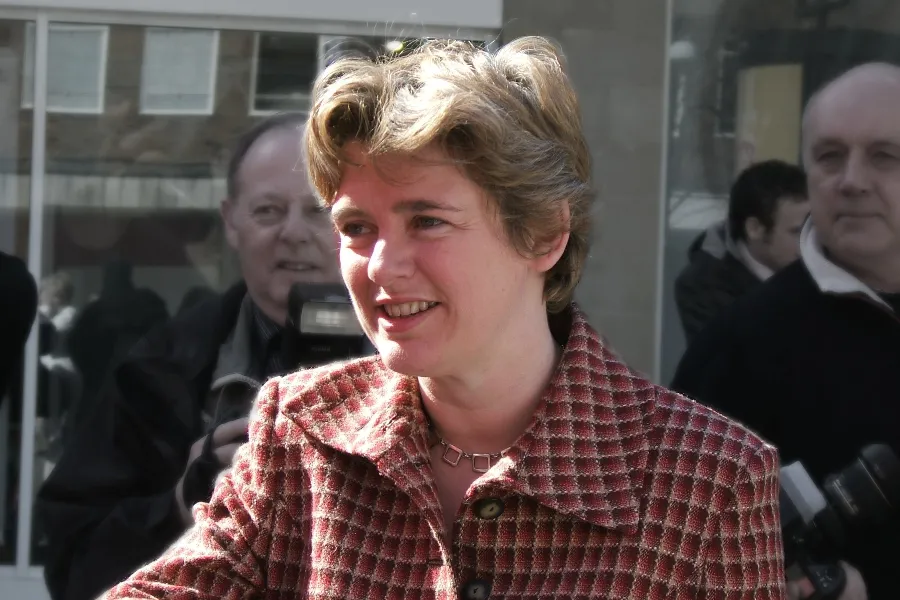
Ruth Kelly, pictured in 2006. / skuds via Flickr (CC BY-SA 2.0).
The Council for the Economy is also currently implementing an investment policy for the Vatican and “a huge training program” in financial standards for those who work in its departments and dicasteries, according to Kelly.
“I’m actually very encouraged by the steps that I’ve seen, even though there’s so much to do and so far to go,” she said.
Pope Francis established the Council for the Economy in 2014 as part of his program of financial reform. Kelly was appointed to the council for a six-year term last August along with five other women with backgrounds in banking, finance, asset management, and international law.
“There’s a real recognition that it’s now very important at the heart of the Church to have lay experts involved in overseeing the Vatican accounts and policies and so forth. And that is important, not just in its own sake, but also for the credibility of the process,” Kelly said.
“The ambition is to have international accounting standards applied in full across the Holy See,” she said. “That’s not a position which we have arrived at yet, but it is one to which we aspire.”
Kelly spoke at the webinar series, “Inspiring Trust: Church Communications and Organizational Vulnerability,” offered by the Pontifical University of the Holy Cross in Rome. The university is entrusted to Opus Dei, with which Kelly is associated.
“To be brutally honest about it, from my perspective of the council’s perspectives … it’s not clear how funds have been flowing and how they’ve been managed because the transparency hasn’t been there,” she said.
Kelly is adamant that “once that transparency is there, and international standards are applied, then you can start talking altogether differently about the Vatican’s role and its responsibility and how it manages money, and so forth.”
“If someone’s going to put money into the Peter’s Pence account, they need to know that that money is being well spent. And at the moment, you can’t say definitely that we can show that, but we’re well on the way I think to be able to do that before too long,” she said.
The Council of the Economy was very focused on cost restraint in setting this year’s budget, asking Vatican departments to come up with reductions in their spending, Kelly explained.
The Vatican’s budget, which already operated on a deficit, took another hit in 2020 and the beginning of 2021, when the Vatican Museums, a major source of income, was forced to close for months.
For the Holy See, the coronavirus crisis also meant collapsing market investments, uncertain income from real estate investments, and diminished contributions from the Church around the world.
“The Holy See suffered, along with every other organization, or many other organizations, in the pandemic, and that’s not surprising. And the question really for the council is how much of that is temporary and how much of that will bounce back,” she said.
“And it is the case that fundraising has been severely dented through the COVID crisis, not surprisingly, as it has been felt right throughout the Church,” she said.
“So, you know, it is one of the areas in our minds, as we think about how to restore the reputation and how to create a strong reputation for how the Holy See manages finances.”
Kelly is confident that there is a strong willingness among both the lay members and the cardinals on the council to “make an impact quickly.”
“We do expect results, very significant results, before the six years run out at the end of the council’s current term,” she said.
German Cardinal Reinhard Marx has overseen the council since its creation in 2014. Other cardinals currently on the council include Joseph Tobin of Newark; Anders Arborelius of Stockholm; Péter Erdő of Esztergom-Budapest; Odilo Scherer of São Paulo; Gérald Lacroix of Quebec; Giuseppe Petrocchi of L’Aquila; and Cardinal Daniel DiNardo of Galveston-Houston.
Among the lay members are German law professor Charlotte Kreuter-Kirchhof; Maria Kolak, president of the National Association of German Cooperative Banks; Alberto Minali, the former chief investment officer of the asset management group Eurizon; Leslie Ferrar, who was treasurer to Britain’s Prince Charles; elevator manufacturer Zardoya Otis; and Eva Castillo Sanz, who sits on the board of directors of the Spanish bank Bankia.
Kelly said: “One of the things that’s on my mind to really explore as we go forward is how the whole whistleblowing setup works in the Vatican. Because I think part of an open culture is not only financial transparency but the ability of people to raise issues in private, perhaps without being identified or only identified if they so wish.”
“Now I do know that whistleblowing happens, but I’m not yet sure that that works well enough within the Holy See, and the Vatican.”
“There is a huge way to go, but I do think the will is there at the very top to see change happen,” she said.
Lourdes, France, Jun 6, 2019 / 10:09 am (CNA).- Pope Francis has appointed a special delegate to oversee the pastoral care of pilgrims and other management at the Marian shrine of Our Lady of Lourdes in France.
Young people are the present and the future of the Church. “The secularized world is an exciting world for an apostle and a missionary” – His Eminence Cardinal Juan José Omella.
Re title – Or it could signify that Spain is just a stone’s throw from Portugal.
Sorry to be such a sceptic but I read the article listed above these comments: “Bishop warns of the ‘desolate panorama” of Spain’s birthrate”.
But, about the larger synodal drift toward doormat welcoming and, some say, a blended and indifferent faith, perhaps we have a clue from Spanish history…On the heels of the Second Vatican Council, observer and author Jean Guitton proposed that:
“Islam [in Iberia 711-1492 A.D.] has not wanted to choose between Heaven and Earth. It proposed instead a blending of heaven and earth, sex and mysticism, war and proselytism, conquest and apostolate. In more general terms, Islam proposed a blending of the spiritual and the temporal worlds […]” (Great Heresies and Church Councils, 1965).
Something like not-so-young versions of synodality— within the Church itself as a blending of formal Church teaching and informal and signaled moral exemptions for this and that, and globally as a blended fraternity within a “pluralism” of equivalent (?) religions?
Still, apart from such foggy nuance, a positively good sign—the Spanish youth and all youth at World Youth Day. As Pope Francis remarked in the 2013 WYD: “Yes, I am asking you to rebel against this culture that sees everything as temporary and that ultimately believes you are incapable of responsibility—that believes you are incapable of true love. . .
All of Portugal is bordered by Spain [Portugal would be a Spanish province if it weren’t for English archers sent to defend their sovereignty]. The numbers of Spanish youth is expected. Nevertheless, a hopeful sign. Photos of young, smiling youth mainly from other European nations, the US, S America and elsewhere speaks to the work of the Holy Spirit.
Despite misgivings on the messaging, Robert Royal seen with a group attending lectures assures the truth will also be served. There also appears to be faithful priests among them. That may carry the day.



Young people are the present and the future of the Church. “The secularized world is an exciting world for an apostle and a missionary” – His Eminence Cardinal Juan José Omella.
Re title – Or it could signify that Spain is just a stone’s throw from Portugal.
Sorry to be such a sceptic but I read the article listed above these comments: “Bishop warns of the ‘desolate panorama” of Spain’s birthrate”.
Very encouraging and uplifting.
But, about the larger synodal drift toward doormat welcoming and, some say, a blended and indifferent faith, perhaps we have a clue from Spanish history…On the heels of the Second Vatican Council, observer and author Jean Guitton proposed that:
“Islam [in Iberia 711-1492 A.D.] has not wanted to choose between Heaven and Earth. It proposed instead a blending of heaven and earth, sex and mysticism, war and proselytism, conquest and apostolate. In more general terms, Islam proposed a blending of the spiritual and the temporal worlds […]” (Great Heresies and Church Councils, 1965).
Something like not-so-young versions of synodality— within the Church itself as a blending of formal Church teaching and informal and signaled moral exemptions for this and that, and globally as a blended fraternity within a “pluralism” of equivalent (?) religions?
Still, apart from such foggy nuance, a positively good sign—the Spanish youth and all youth at World Youth Day. As Pope Francis remarked in the 2013 WYD: “Yes, I am asking you to rebel against this culture that sees everything as temporary and that ultimately believes you are incapable of responsibility—that believes you are incapable of true love. . .
“Have the courage ‘to swim against the tide [!].”
All of Portugal is bordered by Spain [Portugal would be a Spanish province if it weren’t for English archers sent to defend their sovereignty]. The numbers of Spanish youth is expected. Nevertheless, a hopeful sign. Photos of young, smiling youth mainly from other European nations, the US, S America and elsewhere speaks to the work of the Holy Spirit.
Despite misgivings on the messaging, Robert Royal seen with a group attending lectures assures the truth will also be served. There also appears to be faithful priests among them. That may carry the day.