Schoolchildren eagerly wait for the pope’s arrival outside of the apostolic prefecture on Sept. 1, 2023, in Ulaanbaatar, Mongolia, where Pope Francis will be staying for the duration of his four-day visit to the country. / Credit: Colm Flynn/EWTN News
Ulaanbaatar, Mongolia, Sep 1, 2023 / 11:48 am (CNA).
Pope Francis received an enthusiastic welcome to Mongolia on Friday morning after a nearly 10-hour flight on the papal plane.
Upon his arrival at Chinggis Khaan International Airport at 9:52 a.m. local time on Friday, Sept. 1, Pope Francis was greeted with a bowl of Aaruul, dried curds that are a traditional food of Mongolia’s nomadic peoples.
Upon his arrival at Chinggis Khaan International Airport on Sept. 1, 2023, Pope Francis was welcomed with a bowl of Aaruul, dried curds which are a traditional food of Mongolian nomadic peoples. Credit: Vatican Media
A Mongolian cell service provider sent out a public service text message to all of its users to inform them of the pope’s arrival. The message said: “The Roman pope is visiting Mongolia for the first time in our history. Let’s welcome him with kind nomadic hospitality and enjoy the precious moments together.”
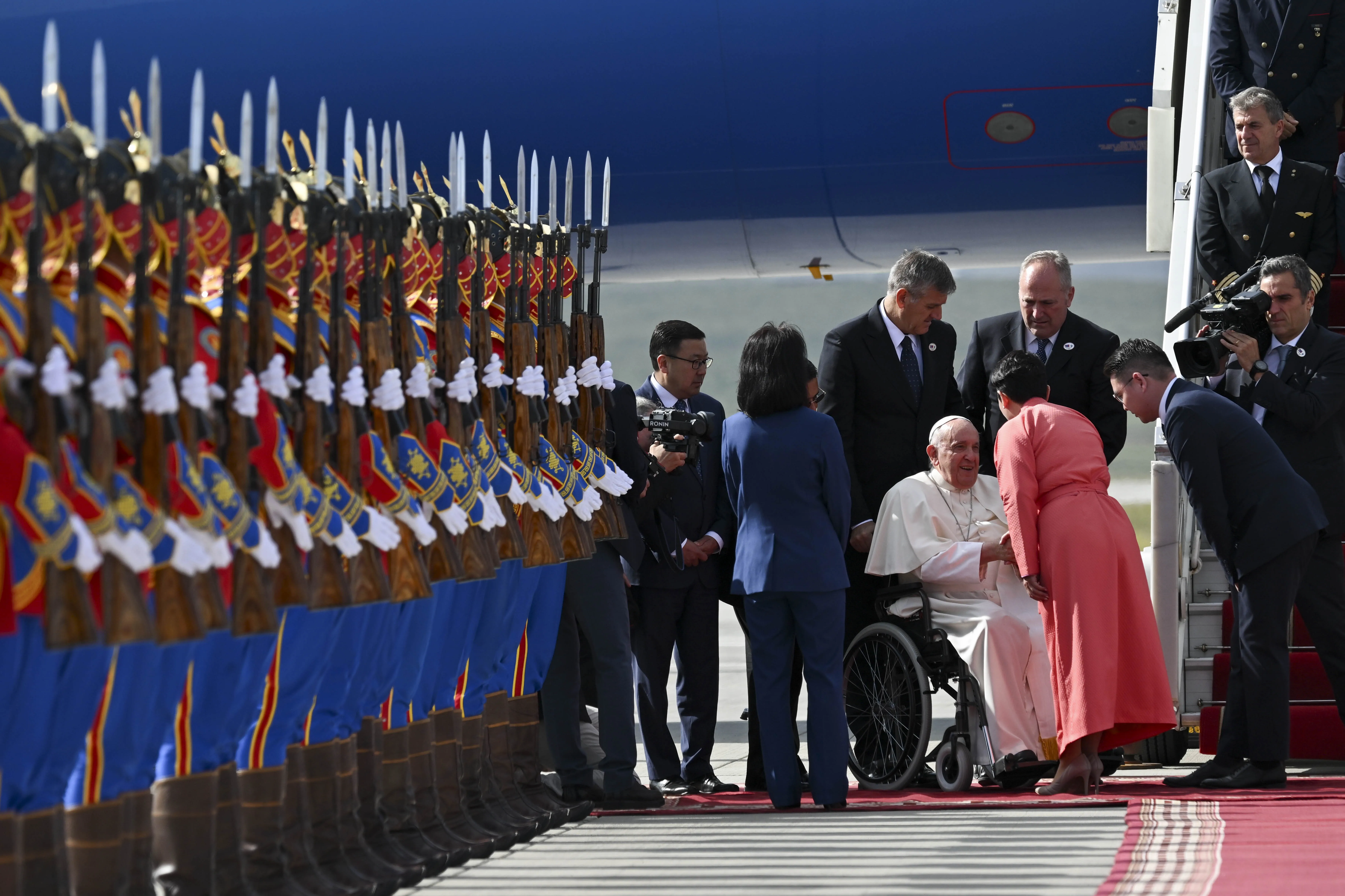
The 86-year-old pope was rolled in his wheelchair down a long red carpet flanked by the Mongolian State Honor Guard, who saluted the first pope to ever visit the Asian country.
The Mongolian State Honor Guard stands at attention for the pope’s arrival at Chinggis Khaan International Airport on Sept. 1, 2023. Pope Francis is the first pope in history to visit the Asian country. Credit: Vatican Media
Cardinal Giorgio Marengo was one of the first to welcome Pope Francis to Mongolia. Marengo is an Italian cardinal who has served as a missionary in Mongolia for nearly 20 years. He is the current apostolic prefect of Ulaanbaatar, Mongolia, and the world’s youngest cardinal.
Cardinal Giorgio Marengo was one of the first to welcome Pope Francis to Mongolia on Sept. 1, 2023. Marengo is an Italian cardinal who has served as a missionary in Mongolia for nearly 20 years. He is the current apostolic prefect of Ulaanbaatar, Mongolia, and the world’s youngest cardinal. Credit: Vatican Media
Mongolian Foreign Minister Battsetseg Batmunkh also met with the pope before the pope was taken to the Mongolian apostolic prefecture.
Mongolian Foreign Minister Battsetseg Batmunkh received Pope Francis at Chinggis Khaan International Airport and later met with him on his first day in Mongolia on Sept. 1, 2023. Credit: Vatican Media
At the apostolic prefecture, where Pope Francis will be staying for the duration of the four-day trip, he was greeted with enthusiasm by representatives of Mongolia’s small Catholic community of only 1,450 Catholics.
At the apostolic prefecture on Sept. 1, 2023, in Ulaanbaatar, Mongolia, where Pope Francis will be staying for the duration of the four-day trip, the pope is greeted with enthusiasm by representatives of Mongolia’s small Catholic community of only 1,450 Catholics. Credit: Colm Flynn/EWTN News
Schoolchildren eagerly waited for the pope’s arrival outside of the prefecture, where Marengo resides. Some children performed traditional Mongolian dances for the pope and were excited to receive rosary beads as a gift.
Two dancers who performed for Pope Francis upon his arrival at the apostolic prefecture in Ulaanbaatar, Mongolia, on Sept. 1, 2023, were proud to show the rosary beads the Holy Father gave them. Credit: Colm Flynn/EWTN News
After the welcome, Pope Francis spent his first day resting before his scheduled speeches and meetings on Saturday and Sunday.
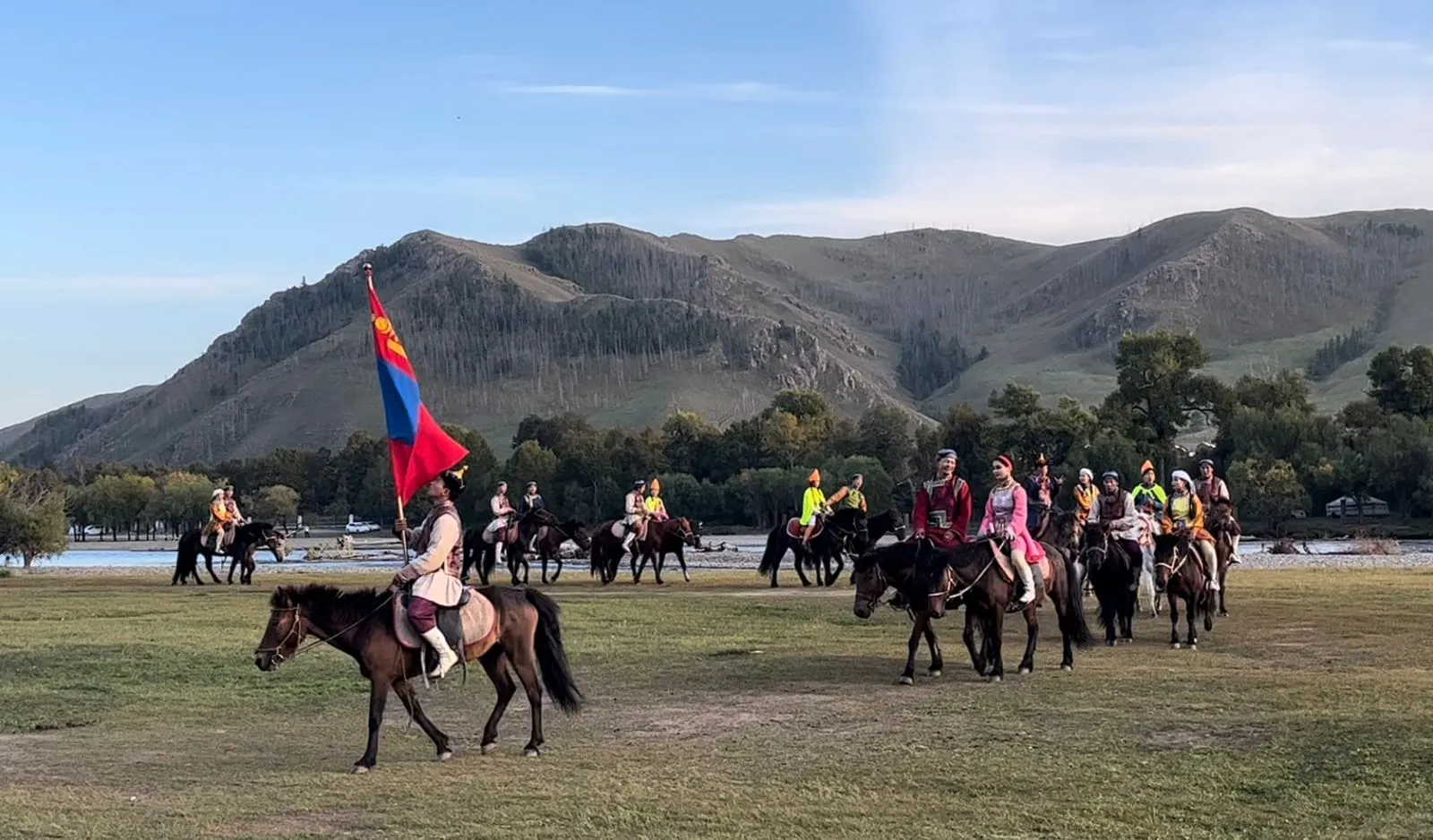
Cardinals, visiting Catholics, and the Vatican press corps were invited to experience Mongolian culture at a “Besreg Naadam” festival 24 miles outside the capital city of Ulaanbaatar.
Cardinals, visiting Catholics, and the Vatican press corps were invited to experience Mongolian culture at a “Besreg Naadam” festival 24 miles outside the capital city of Ulaanbaatar on Sept. 1, 2023. The festival was filled with traditional Mongolian dancing, a wrestling tournament, musical performances, an archery competition, and a daring equestrian acrobatics show. Credit: Courtney Mares/CNA
The festival was filled with traditional Mongolian dancing, a wrestling tournament, musical performances, an archery competition, and a daring equestrian acrobatics show.
Cardinals, visiting Catholics, and the Vatican press corps were invited to experience Mongolian culture at a “Besreg Naadam” festival 24 miles outside the capital city of Ulaanbaatar on Sept. 1, 2023. The festival was filled with traditional Mongolian dancing, a wrestling tournament, musical performances, an archery competition, and a daring equestrian acrobatics show. Credit: Courtney Mares/CNA
Cardinals, visiting Catholics, and the Vatican press corps were invited to experience Mongolian culture at a “Besreg Naadam” festival 24 miles outside the capital city of Ulaanbaatar on Sept. 1, 2023. The festival was filled with traditional Mongolian dancing, a wrestling tournament, musical performances, an archery competition, and a daring equestrian acrobatics show. Credit: Courtney Mares/CNA
Cardinal Pietro Parolin, Cardinal Luis Antonio Tagle, Cardinal Kurt Koch, Cardinal-elect Stephen Chow, and other visiting clerics all participated in the festival.
Pope Francis’ first public event will be a welcome ceremony in the city’s Sükhbaatar Square with President Ukhnaagiin Khürelsükh on Sept. 2. He will later meet with the country’s small Catholic community in the city’s Cathedral of Sts. Peter and Paul in the afternoon.
Pope Francis told journalists in the press corps traveling with him that to visit Mongolia is to encounter “a small people, but a big culture.”
“I think it will do us good to understand this silence … to understand what it means, but not intellectually, with the senses. Mongolia can be understood with the senses,” the pope said.
Cardinals, visiting Catholics, and the Vatican press corps were invited to experience Mongolian culture at a “Besreg Naadam” festival 24 miles outside the capital city of Ulaanbaatar on Sept. 1, 2023. The festival was filled with traditional Mongolian dancing, a wrestling tournament, musical performances, an archery competition, and a daring equestrian acrobatics show. Credit: Courtney Mares/CNA
Cardinals, visiting Catholics, and the Vatican press corps were invited to experience Mongolian culture at a “Besreg Naadam” festival 24 miles outside the capital city of Ulaanbaatar on Sept. 1, 2023. The festival was filled with traditional Mongolian dancing, a wrestling tournament, musical performances, an archery competition, and a daring equestrian acrobatics show. Credit: Courtney Mares/CNA
Cardinals, visiting Catholics, and the Vatican press corps were invited to experience Mongolian culture at a “Besreg Naadam” festival 24 miles outside the capital city of Ulaanbaatar on Sept. 1, 2023. The festival was filled with traditional Mongolian dancing, a wrestling tournament, musical performances, an archery competition, and a daring equestrian acrobatics show. Credit: Courtney Mares/CNA
Cardinals, visiting Catholics, and the Vatican press corps were invited to experience Mongolian culture at a “Besreg Naadam” festival 24 miles outside the capital city of Ulaanbaatar on Sept. 1, 2023. The festival was filled with traditional Mongolian dancing, a wrestling tournament, musical performances, an archery competition, and a daring equestrian acrobatics show. Credit: Courtney Mares/CNA
Schoolchildren eagerly wait for the pope’s arrival outside of the apostolic prefecture on Sept. 1, 2023, in Ulaanbaatar, Mongolia, where Pope Francis will be staying for the duration of his four-day visit to the country. Credit: Colm Flynn/EWTN News
Pope Francis greets the crowds at the apostolic prefecture on Sept. 1, 2023, in Ulaanbaatar, Mongolia, where the pope will be staying for the duration of the four-day trip. The pope was met with enthusiasm by representatives of Mongolia’s small Catholic community of only 1,450 Catholics. Credit: Colm Flynn/EWTN News
Cardinals, visiting Catholics, and the Vatican press corps were invited to experience Mongolian culture at a “Besreg Naadam” festival 24 miles outside the capital city of Ulaanbaatar on Sept. 1, 2023. The festival was filled with traditional Mongolian dancing, a wrestling tournament, musical performances, an archery competition, and a daring equestrian acrobatics show. Credit: Courtney Mares/CNA
Cardinals, visiting Catholics, and the Vatican press corps were invited to experience Mongolian culture at a “Besreg Naadam” festival 24 miles outside the capital city of Ulaanbaatar on Sept. 1, 2023. The festival was filled with traditional Mongolian dancing, a wrestling tournament, musical performances, an archery competition, and a daring equestrian acrobatics show. Credit: Courtney Mares/CNA
Cardinals, visiting Catholics, and the Vatican press corps were invited to experience Mongolian culture at a “Besreg Naadam” festival 24 miles outside the capital city of Ulaanbaatar on Sept. 1, 2023. The festival was filled with traditional Mongolian dancing, a wrestling tournament, musical performances, an archery competition, and a daring equestrian acrobatics show. Credit: Courtney Mares/CNA
Cardinals, visiting Catholics, and the Vatican press corps were invited to experience Mongolian culture at a “Besreg Naadam” festival 24 miles outside the capital city of Ulaanbaatar on Sept. 1, 2023. The festival was filled with traditional Mongolian dancing, a wrestling tournament, musical performances, an archery competition, and a daring equestrian acrobatics show. Credit: Courtney Mares/CNA
If you value the news and views Catholic World Report provides, please consider donating to support our efforts. Your contribution will help us continue to make CWR available to all readers worldwide for free, without a subscription. Thank you for your generosity!
Click here for more information on donating to CWR. Click here to sign up for our newsletter.
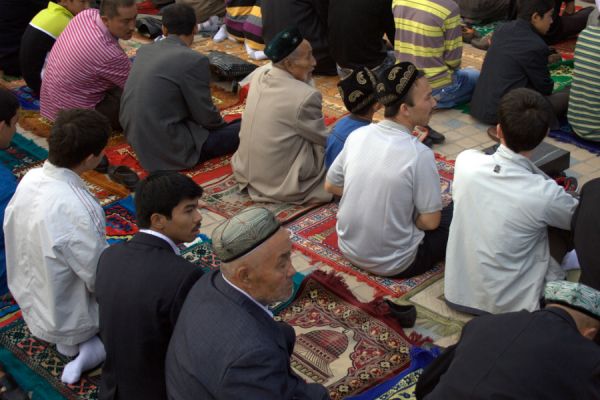
Beijing, China, Jul 24, 2019 / 12:15 pm (CNA).- An article published Wednesday in a state-run paper from mainland China repeated government talking points regarding the situations of the Uighurs, a Muslim ethnoreligious group in the country’s northwest.
Some 1 million Uighurs have been detained in re-education camps for Muslims in China’s Xinjiang Uyghur Autonomous Region. Inside the camps they are reportedly subjected to forced labor, torture, and political indoctrination. Outside the camps, Uyghurs are monitored by pervasive police forces and facial recognition technology.
Uighurs can be arrested and detained under vague anti-terrorism laws. Violence in the region escalated in the 1990s and again in 2008.
In August 2014 officials in Karamay, a city of Xinjiang, banned “youths with long beards” and anyone wearing headscarves, veils, burqas, or clothes with the crescent moon and star symbol from using public transit. That May, universities across the region banned fasting during Ramadan.
The Chinese government has said reports on the camps by Western governments and media are unfounded, claiming they are vocational training centers and that it is combatting extremism.
Li Yang, an author at China Daily, an English language daily owned by the Communist Party of China, wrote July 24 that “Western critics of China’s policies on human rights and religious freedom in the Xinjiang Uygur autonomous region seem to be divorced from the realities of the situation.”
Li’s piece focused on “Uygur separatists” who try “to brainwash the other Uygurs with extremism and terrorism.”
He said that “all the measures that Beijing has taken to fight separatism, extremism and terrorism in Xinjiang are part of the global anti-terrorism campaign, as well as an integral part of China’s efforts to boost local development.”
Li noted that the Chinese government has set up “vocational educational centers” in Xinjiang, as well as “installing surveillance systems and deploying security forces.”
He also pointed out that 150 million tourists visited Xinjiang last year, and that the autonomous region’s economy has risen 40 percent over the past five years.
According to Li, “the religious freedom of all ethnic groups … is strictly protected by law.”
Li focused on the diversity of Xinjiang, saying that separatists ignore the interest of the region’s other ethnic groups. Uighurs make up about 46% of the region’s population; Han Chinese 39%, Kazakhs 7%, and Huis 5%. A large number of minorities make up the remaining 3%.
Attention was drawn to the human and religious rights situation in Xinjiang at the recent Ministerial to Advance Religious Freedom held by the US State Department last week.
US Secretary of State Mike Pompeo said July 18 at the gathering that survivors of the detention camps have described “a deliberate attempt by Beijing to strangle Uighur culture and stamp out” Islam.
In response, Chinese officials have been outspoken in defense of policies in the region.
A letter signed by Chinese scholars and religious officials posted July 19 by the Xinjiang government said Pompeo should “stop fabricating lies and slander about Xinjiang.”
An editorial published in the People’s Daily July 20 claims that China actually respects religious rights, and said that the United States has an “ulterior motive” to criticize China’s treatment of religious minorities.
“They even use so-called freedom of religious belief as an excuse to undermine China’s national harmony and interfere in China’s internal affairs,” the editorial said.
And the Chinese State Council Information Office released a white paper July 21 that claimed, among other things, that Xinjiang is a region where religious freedom is respected, and that the Uighur population did not choose to become Muslim.
In June, Rep. Chris Smith (R-NJ) told a congressional hearing that China’s campaign to “sinicize” religion is proceeding with brutal efficiency. “Under ‘sinicization,’ all religions and believers must comport with and aggressively promote communist ideology — or else,” Smith said.
“It’s never been worse than it is right now.”
“Religious believers of every persuasion are harassed, arrested, jailed, or tortured. Only the compliant are left relatively unscathed. Bibles are burned, churches are destroyed, crosses set ablaze atop church steeples,” Smith said.
Jolo, Philippines, Aug 31, 2020 / 04:25 pm (CNA).- Following twin bombings in a southern region of the Philippines, a local bishop is asking the government not to impose martial law without first listening to the citizens.







Thanks for the beautiful pictures of the rich and unique aspects of the Mongolian culture.