Washington, D.C. Newsroom, Nov 22, 2024 / 17:20 pm (CNA).
The national anti-poverty program run by U.S. bishops has released its annual report from 2023, revealing that it spent $11.4 million more than it collected.
The Catholic Campaign for Human Development (CCHD) Annual Report 2023 revealed that the program ended the year with a net operating deficit of $2,830,364 after spending more than the combined total of its $8,451,156 savings and the $7,284,574 in revenue it collected this year.
The CCHD is a nationwide anti-poverty program run by the United States Conference of Catholic Bishops (USCCB) that raises money every year and allocates funding to charitable organizations that benefit the poor.
In total, the organization dedicated to “breaking the cycle of poverty” spent $18,696,903 overall despite having just $15,735,730 in available funds after clearing out its accumulated assets.
Bishop Timothy Senior of Harrisburg, Pennsylvania, who chairs the Subcommittee on the Catholic Campaign for Human Development, stated in the annual report that the various charitable projects that received CCHD funds mentioned represent “a small taste of how CCHD invested $7.3 million of [donor] gifts in grants in 2023 to help people help each other.”
The CCHD has not published a list of grantees since 2022, though USCCB spokesperson Chieko Noguchi told CNA this week that she expects CCHD’s 2023 grantee list to be “posted soon.”
CCHD’s recent difficulties and past controversy
The CCHD annual report documenting its financial difficulties comes after its former director, Ralph McCloud, resigned from his position in April. In June, several USCCB social justice employees working for the Department of Justice, Peace, and Human Development, which oversees CCHD, were laid off. Bishops had privately discussed the CCHD during its June plenary assembly ahead of the layoffs.
Noguchi told the National Catholic Register, CNA’s sister news partner, at the time that the layoffs were part of a “reorganization” geared toward enabling the conference to “align resources more closely with recent funding trends.”
“The CCHD subcommittee will continue its work,” she continued, adding: “In the interest of good stewardship, the administration of the collection is being reorganized to allow for more efficient management.”
McCloud is now a fellow at a social justice political advocacy group called NETWORK, which was founded by Catholic Sisters in 1972.
Over the years the program has generated controversy and criticism. Beginning in 2008, the CCHD was faulted by activists — and some Catholic bishops — for funding organizations that have taken positions contrary to Church teaching, such as on abortion and same-sex marriage.
In 2010, the USCCB instituted new controls to help ensure that grantees conform with Catholic teaching.
If you value the news and views Catholic World Report provides, please consider donating to support our efforts. Your contribution will help us continue to make CWR available to all readers worldwide for free, without a subscription. Thank you for your generosity!
Click here for more information on donating to CWR. Click here to sign up for our newsletter.
Washington D.C., Aug 14, 2019 / 09:30 am (CNA).- On Aug. 15, Catholics around the world mark the Feast of the Assumption of Mary, commemorating the end of her earthly life and assumption into Heaven.
But while the feast day is a relatively new one, th… […]
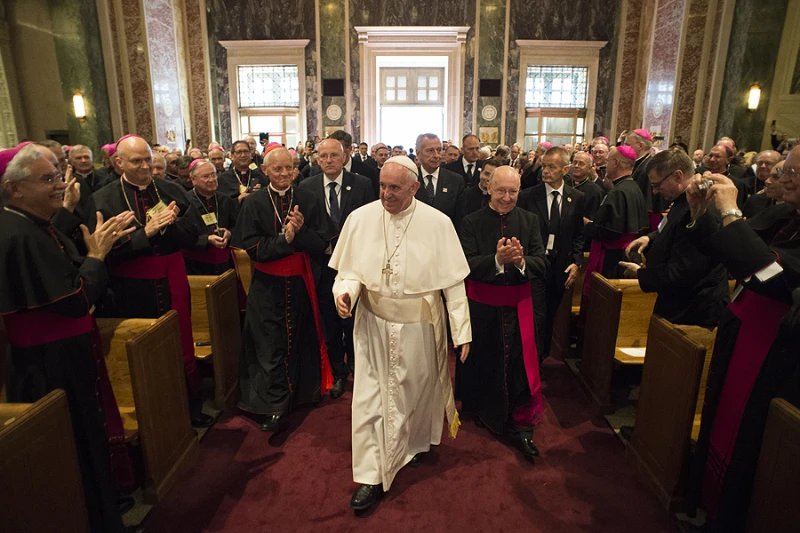
Pope Francis meets with the United States bishops at St. Matthew’s Cathedral in Washington, D.C., on Sept. 23, 2015. / Credit: L’Osservatore Romano
CNA Staff, Apr 22, 2025 / 07:00 am (CNA).
Pope Francis, who died on April 21 at the age of 88, visited the United States just once, nearly 10 years ago, in September 2015.
Despite the brevity of the visit, he accomplished a lot: Attracting hundreds of thousands of participants, he canonized a new saint (St. Junípero Serra), became the first pope to ever address a joint session of Congress, and galvanized the U.S. Catholic community with his presence and his speeches on the East Coast.
Washington, D.C.
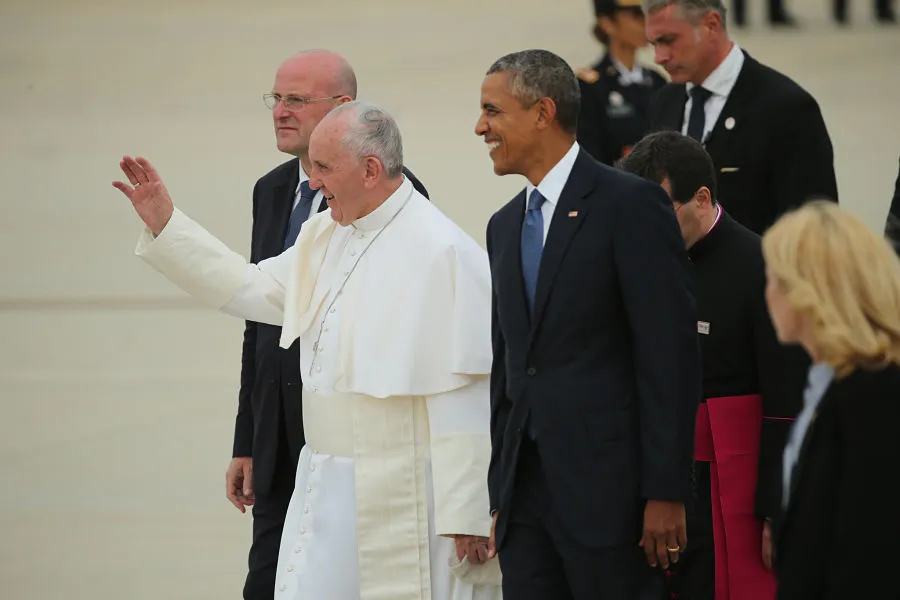
Pope Francis began his tour of North America with several days in Cuba. Landing in Washington, D.C., on Sept. 22, 2015, Pope Francis met with President Barack Obama first thing the next morning. The meeting came amid a time of concerns for many American Catholics regarding politics, including the Obama administration’s contraceptive mandate and the recent legalization of same-sex marriage nationwide, via the June 2015 Supreme Court decision in Obergefell v. Hodges.
Pope Francis is greeted by President Barack Obama on Sept. 22, 2015. Credit: Somodevilla/Getty Images
During the presidential meeting, Francis praised Obama’s commitment to inclusivity and noted that American Catholics have contributed greatly to building a tolerant and inclusive society while also stressing that religious liberty “remains one of America’s most precious possessions.” He also encouraged commitment to addressing the “urgent” issue of climate change, building on his expansive 2015 encyclical on the environment, Laudato Si’.
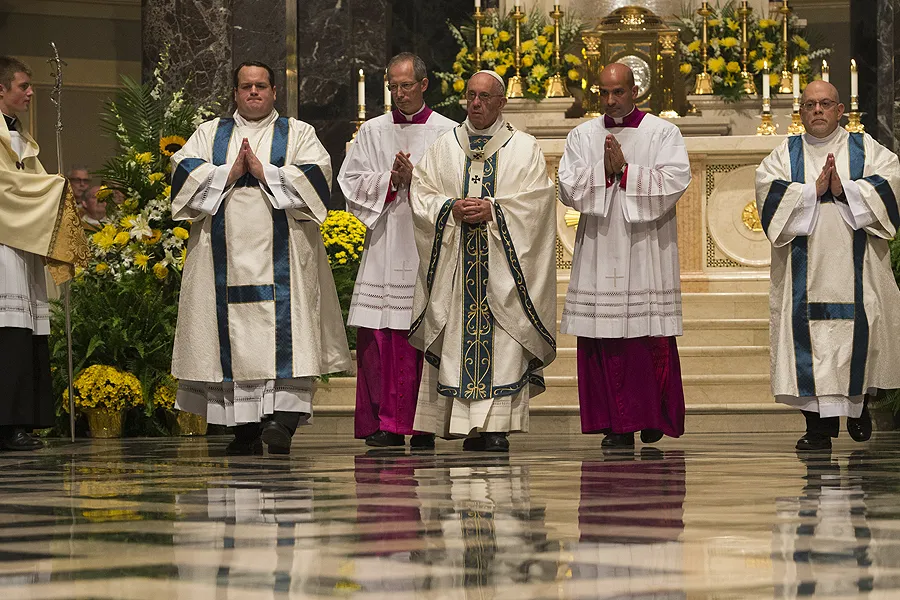
Pope Francis says Mass for clergy and religious in Philadelphia’s Cathedral Basilica of Sts. Peter and Paul, Sept. 26, 2015. Credit: L’Osservatore Romano.
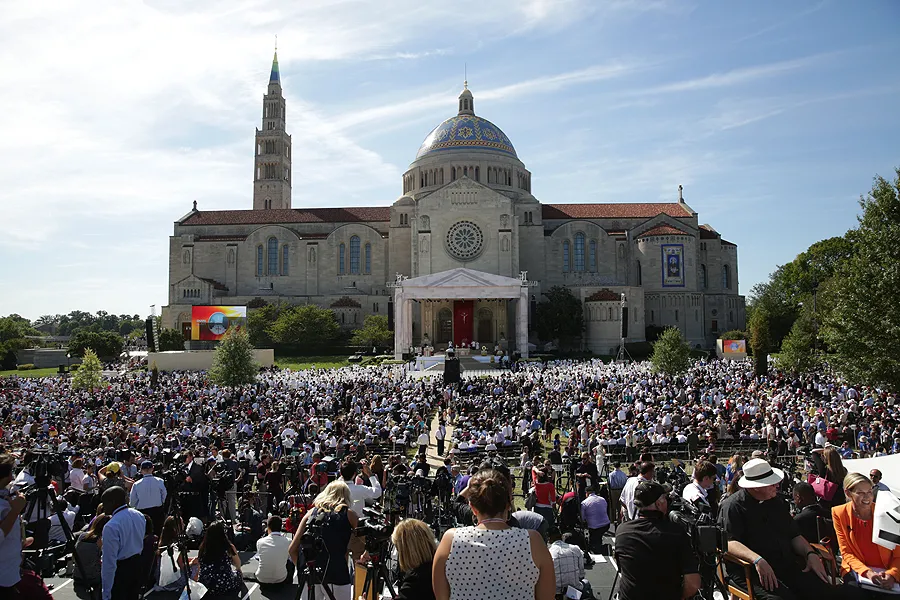
While in D.C., that same day, the pope addressed bishops and priests at the Cathedral of St. Matthew the Apostle and later celebrated Mass at the Basilica of the National Shrine of the Immaculate Conception. At the latter Mass, he celebrated the first canonization on American soil by declaring Junípero Serra, who founded missions along present-day California, a saint.
“He was the embodiment of ‘a Church which goes forth,’ a Church which sets out to bring everywhere the reconciling tenderness of God,” the pope said.
Crowds gather for the Mass canonizing St. Junipero Serra at the Basilica of the National Shrine of the Immaculate Conception in Washington, D.C., on Sept. 23, 2015. Credit: Alan Holdren/CNA
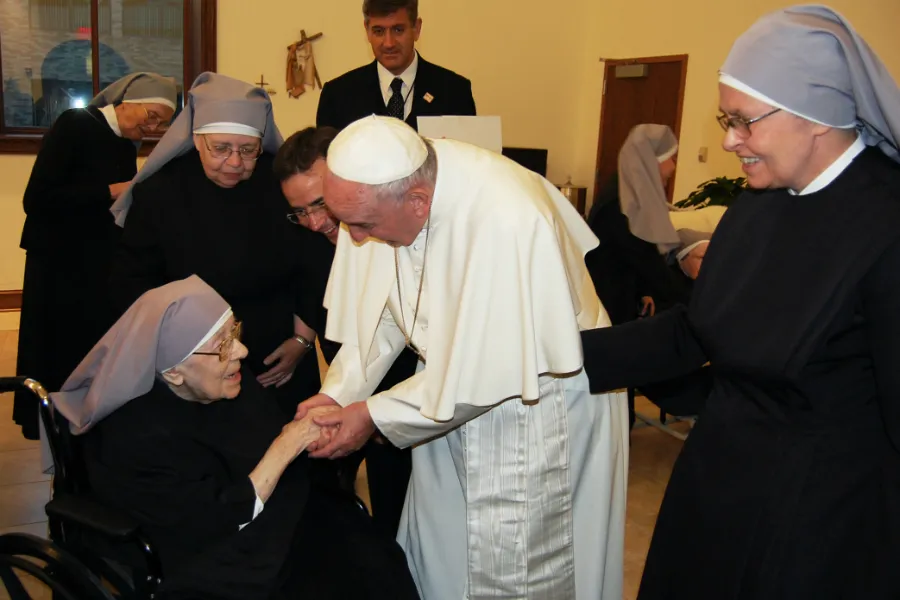
On the same day, Francis made an unscheduled stop to visit with the Little Sisters of the Poor in Washington, D.C., to support the sisters as they awaited word on whether or not the Supreme Court will hear their case against the federal contraception mandate. (The sisters are still fighting aspects of the mandate, even after more than 14 years in court.)
Pope Francis greets Sister Marie Mathilde, 102 years old, at the Jeanne Jugan Residence in Washington, D.C., Sept. 23, 2015. Credit: Photo courtesy of the Little Sisters of the Poor
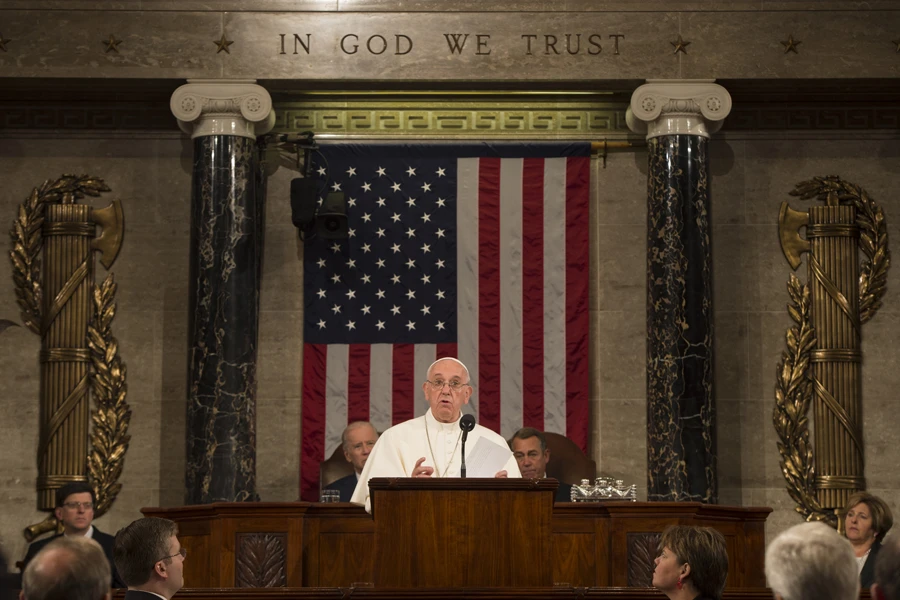
Francis addressed a joint session of Congress the next day, Sept. 24, making him the first pope to ever to do so. During his lengthy speech, he condemned the arms trade and the death penalty — statements that reportedly made some lawmakers in the room squirm.
Francis went on to assert that the family was being threatened like never before and praised American figures, including Abraham Lincoln and Martin Luther King Jr., for their tireless efforts to defend freedom and moral values. He also touched on respect for human life and the environment in the well-received speech.
Pope Francis speaks to the U.S. Congress in Washington, D.C., on Sept. 24, 2015. Credit: L’Osservatore Romano
The pope also visited St. Patrick Parish and met with people experiencing homelessness at Catholic Charities, addressing people who minister to the poor. He offered St. Joseph as their patron and model, because, he said, St. Joseph grappled with injustice and suffering in his care for Mary and Jesus.
“The Son of God came into this world as a homeless person,” the pope said. “The Son of God knew what it was to start life without a roof over his head.”
“We can find no social or moral justification, no justification whatsoever, for lack of housing. There are many unjust situations, but we know that God is suffering with us, experiencing them at our side. He does not abandon us.”
Controversially, while in D.C. Pope Francis met with Kim Davis, a Kentucky county clerk who had become a cultural lightning rod for refusing to issue same-sex marriage licenses. The pope reportedly told her to “stay strong,” offering rosaries to Davis and her husband. The Vatican later clarified that Francis met with Davis and her husband as part of a large group invited by the nunciature, with the Vatican spokesperson adding that the pope “did not enter into the details” of her situation.
New York City
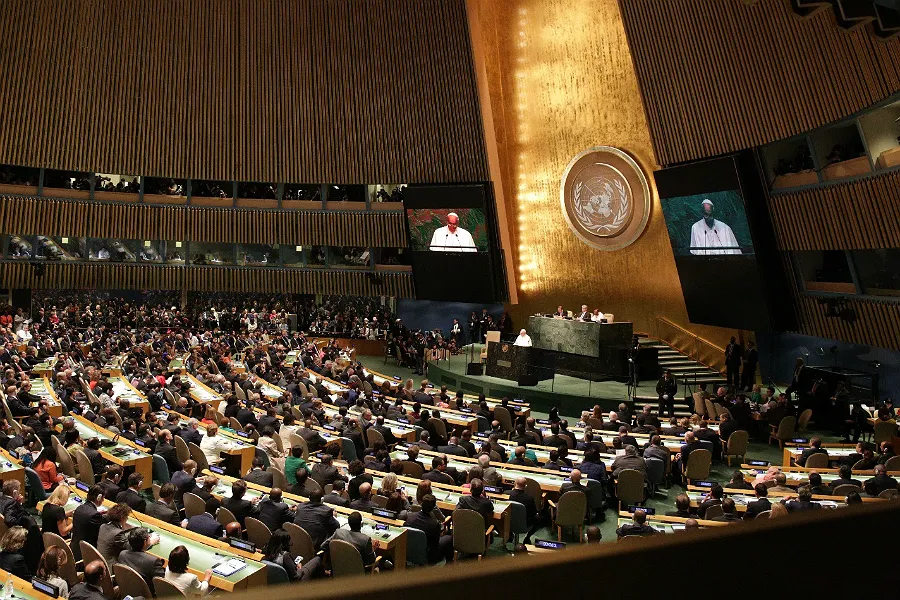
After flying to New York City the evening of Sept. 24 and praying vespers at St. Patrick’s Cathedral in Manhattan, Francis addressed the United Nations General Assembly the next day, Sept. 25, the fifth time a pope had addressed the body.
The pontiff issued a call to the countries of the world to reject what he called “ideological colonization” — the “imposition of anomalous models and lifestyles which are alien to people’s identity and, in the end, irresponsible.”
Pope Francis’ historic address to the U.N. in New York City on Sept. 25, 2015. Credit: Alan Holdren/CNA
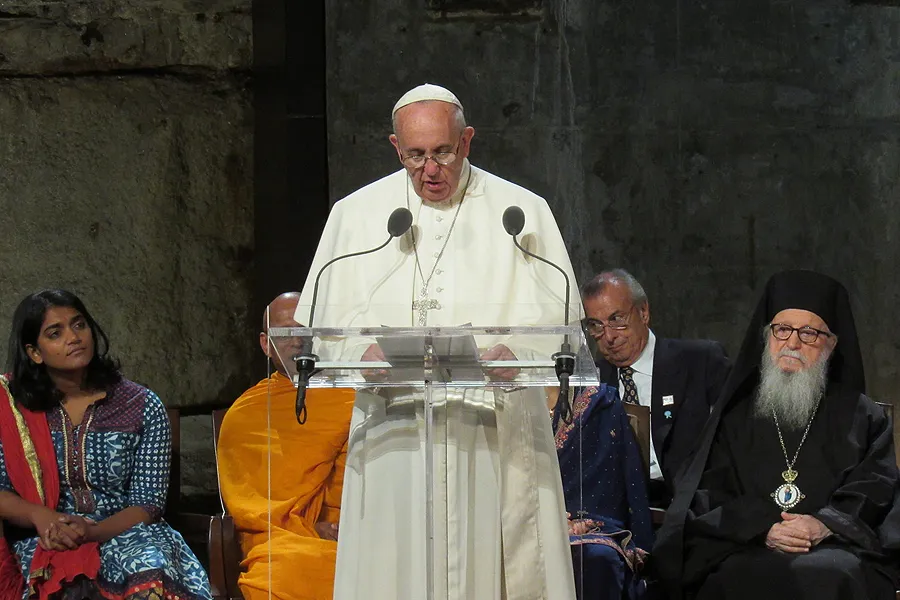
Like his predecessor, Benedict XVI, Pope Francis made a solemn visit with other religious leaders to Ground Zero, the site of the 9/11 attacks, later on Sept. 25. He met with families of first responders, saying at the site museum that acts of destruction always have “a face, a concrete story, names.” He offered a “prayer of remembrance” for all those killed that day, along with a prayer for the survivors and those who are mourning the loss of their loved ones.
Pope Francis speaks during an interreligious prayer service at Ground Zero, Sept. 25, 2015. Credit: Addie Mena/CNA
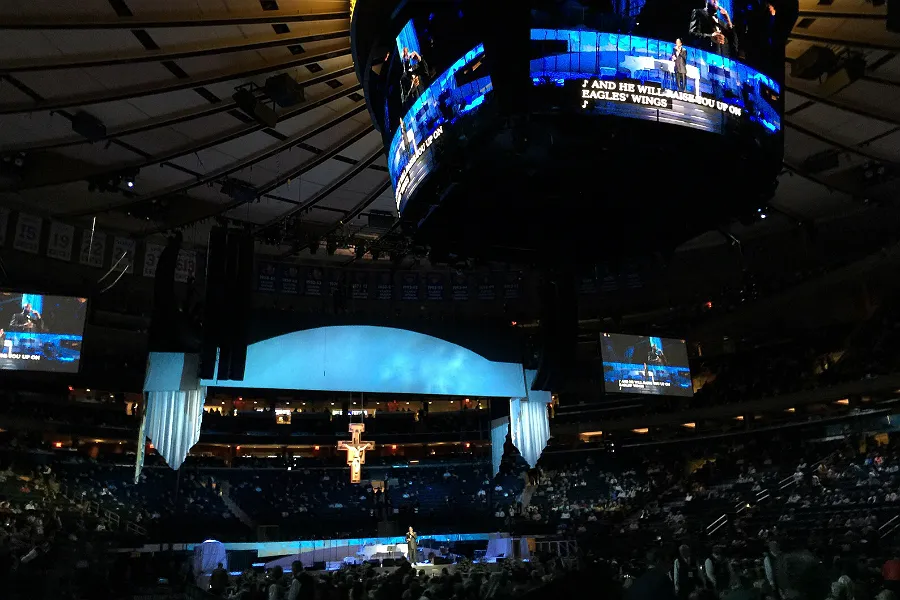
Later that day, after visiting Our Lady, Queen of the Angels School in the Harlem neighborhood of New York City, Francis celebrated Mass at Madison Square Garden. He encouraged people to remember those in the city who are often forgotten, including “foreigners, the children who go without schooling, those deprived of medical insurance, the homeless, the forgotten elderly.”
Madison Square Garden prepares for the papal Mass, Sept. 25, 2015. Credit: Alan Holdren/CNA
“Knowing that Jesus still walks our streets, that he is part of the lives of his people, that he is involved with us in one vast history of salvation, fills us with hope. A hope which liberates us from the forces pushing us to isolation and lack of concern for the lives of others, for the life of our city,” the pope said.
“A hope which frees us from empty ‘connections,’ from abstract analyses, or sensationalist routines. A hope which is unafraid of involvement, which acts as a leaven wherever we happen to live and work. A hope which makes us see, even in the midst of smog, the presence of God as he continues to walk the streets of our city.”
Philadelphia
Pope Francis’ visit included an appearance at the 2015 World Meeting of Families (WMF) in Philadelphia, an event that focuses on celebrating the gift of the family.
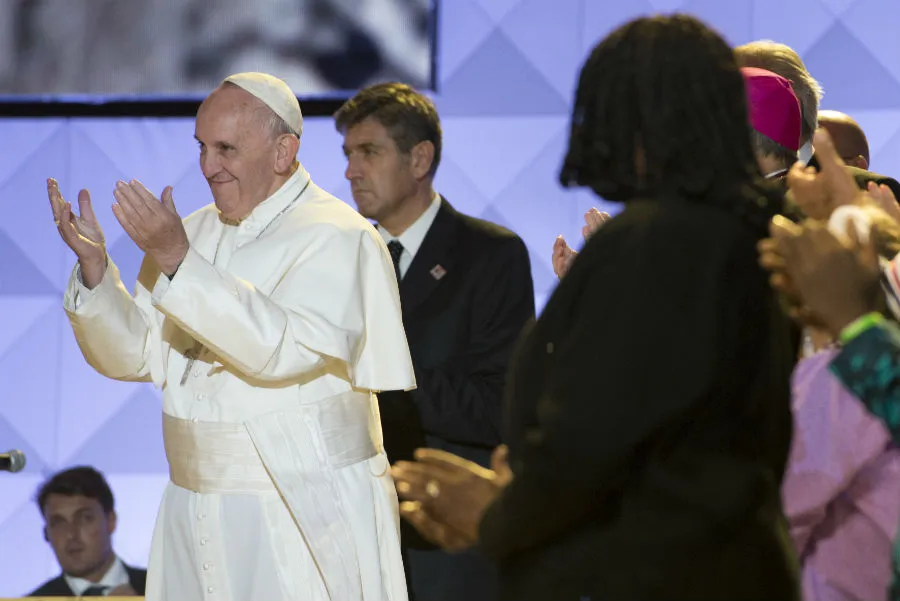
Pope Francis at the World Meeting of Families in Philadelphia on Sept. 26, 2015. Credit: L’Osservatore Romano
After flying to the “City of Brotherly Love” the morning of Sept. 26, Pope Francis took part in a Mass for clergy and religious at Philadelphia’s Cathedral Basilica of Sts. Peter and Paul. In his homily address, the pope challenged the clergy and religious to inspire new vocations.
He called for women to take on a greater role in the Church, highlighting the example of St. Katharine Drexel — a Philadelphia native — and he reminded the priests and religious present of their role in ministering to families, couples preparing for marriage, and young people.
He later addressed a crowd of some 50,000 people at Independence Mall, the site of Independence Hall and the Liberty Bell, for a religious freedom rally with Hispanic and other immigrants.
Speaking to thousands of families gathered on the Benjamin Franklin Parkway in Philadelphia that night, a visibly moved Pope Francis ditched his prepared remarks and instead gave an impromptu reflection on the beauty and dire importance of family life. He voiced his thanks at “the presence of all of you — who are a real witness that it’s worth being a family!” A society “is strong, solid, and edified on beauty, goodness, and truth,” he added.
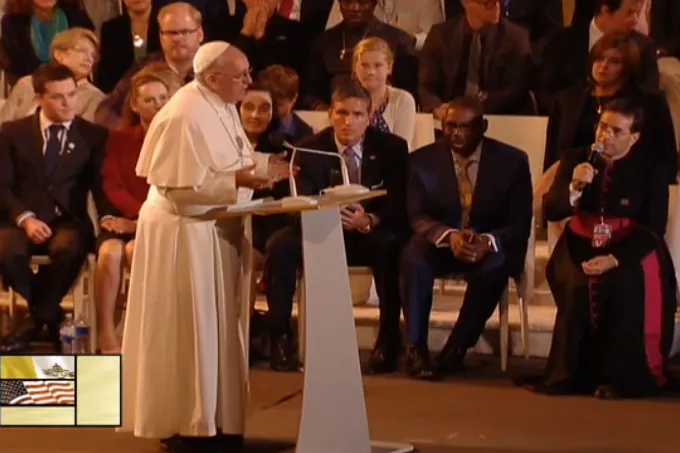
Pope Francis addresses the Festival of Families in Philadelphia on Sept. 26, 2015. Credit: EWTN
On Sept. 27, the next day, Francis had an unscripted meeting with five abuse survivors — three women and two men — all of whom had been abused in childhood either by members of the clergy, family members, or educators. He promised accountability for perpetrators and expressed sorrow for the victims’ suffering.
In the face of such heinous acts as sexual abuse, “God cries,” he said, adding that “the criminal sins of the abuse of minors can’t be kept in silence any longer … I promise, with the vigilance of the Church, to protect minors and I promise [that] all of those responsible will be held accountable.”
He told a gathering of international bishops afterward that the survivors’ stories of suffering “have aggravated my heart” and said that crimes of abuse must never be kept in silence.
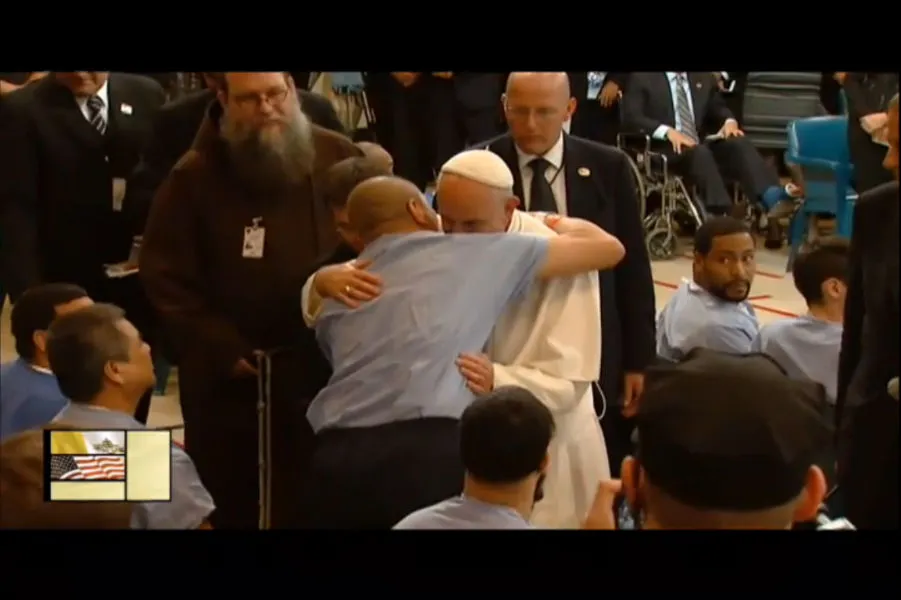
Later that morning, Francis visited a Philadelphia correctional facility, saying at the meeting with a group of 100 inmates and their families that every person is marked and bruised by life, but Jesus washes away our sins and invites us to live a full life.
Pope Francis embraces a man at Curran-Fromhold Correction Facility in Philadelphia on Sept. 27, 2015. Credit: EWTN
Reflecting on the trip, the Holy Father said it was “particularly moving for me to canonize St. Junípero Serra, who reminds us all of our call to be missionary disciples.”
He added that he was touched “to stand with my brothers and sisters of other religions at Ground Zero, that place which speaks so powerfully of the mystery of evil. Yet we know with certainty that evil never has the last word, and that, in God’s merciful plan, love and peace triumph over all.”
Furthermore, he promised his prayers for the U.S. people, saying: “This land has been blessed with tremendous gifts and opportunities. I pray that you may all be good and generous stewards of the human and material resources entrusted to you.”
“I thank the Lord that I was able to witness the faith of God’s people in this country, as manifested in our moments of prayer together and evidenced in so many works of charity.”
Concluding, he asked those present: “Do not let your enthusiasm for Jesus, his Church, our families, and the broader family of society run dry.”
“May our days together bear fruit that will last, generosity and care for others that will endure!” he said. “Just as we have received so much from God — gifts freely given us, and not of our own making — so let us freely give to others in return.”
Shortly after midnight on election night, both President Donald Trump and Democratic candidate Joe Biden had won states key to their election. Trump won swing states Florida and Ohio, and was expected to win North Carolina. Biden was expected to win Arizona, which Trump won in 2016.
Trump led in Georgia, and in swing states Wisconsin and Michigan, but there were still votes to count, and no winner was expected to be announced until Tuesday. Trump led by more than 15 points in Pennsylvania, but urban areas, expected to go toward Biden, had not yet been fully counted. State officials said it could be days until a winner was declared, because mail-in votes still needed to be tallied.
The race is expected to come down to Wisconsin, Michigan, and Pennsylvania. If Pennsylvania is the final piece of either candidate’s path to 270 electoral votes, it could be days before the election was decided, and some expect that litigation could become an issue.
Louisiana voters approved a constitutional amendment to prevent the state’s courts from finding a “right to abortion,” or to public abortion funding, in the state’s constitution.
More than 60% of Louisiana’s voters voted to amend the state constitution to say that “nothing in this constitution shall be construed to secure or protect a right to abortion or require the funding of abortion.”
“Amendment 1 is not a ban on abortion. It simply keeps abortion policy in the hands of our legislators rather than state judges,” state Senator Katrina Jackson, who authored the amendment, explained.
Colorado voters considered a ban on abortions after 22 weeks of pregnancy. The state is one of just seven that allows abortion to take place until birth. Each year, about 200 to 300 babies are aborted after 21-weeks gestation in the state.
While pro-life advocates urged support for a ban on late-term abortion, nearly 60% of voters rejected the proposal.
Late Tuesday night, Democrats were projected to retain control of the House of Representatives. Democrats have pledged to push for federal funding of abortion if they retained control of the House after the 2020 election.
— As election day began, the U.S. bishops urged prayer.
CCHD should have been dismantled a long, long time ago. They are nothing more than an agent doing the work of the atheistic, progressive Democrat Party machine implementing the operational manual of Saul Alinsky. The bishops, those who run CCHD, and those who donate to it will answer to God’s judgment.
So NETWORK was started by a group of Catholic Sisters in 1972? Why does this make me nervous?
And the former director of the Catholic Campaign for Human Development moves into NETWORK?
Catholic Campaign for Human Development began as National Catholic Crusade Against Poverty during the Sixties [approx 1967] under the auspices of Chicago Cardinal Bernadin. Initial project is attributed to a local pastor Fr Dempsey, later bishop Dempsey. In fact it was suggested by and integrated into Saul Alinsky’s 1965 strategy for transforming the Church into an unwitting instrument of Marxist socialism [see Ewtn Wolf in Sheep’s Clothing]. Marxist socialist tactics were used to embarrass and accuse business of illregard for the working poor, setting up class antagonism, elicitation of their funding to Crusade Against Poverty.
Alinsky had a strong, convincing personality exerting his influence in Rome with Paul VI who conveniently authored Populorum progressio 1967. “Maritain was so enthralled with Alinsky’s writing and organizing that in 1958 he personally urged Archbishop Montini of Milan, the future Pope Paul VI, to meet with Alinsky. The Archbishop met with Alinsky in 1965 to explore whether community organizing could work in Italy” (The Influence of Saul Alinsky on The Campaign for Human Development Lawrence J Engel Theological Studies).
Our USCCB has either mismanaged or failed to exert its interests in protecting its own and consequently the Church’s Catholicity. It’s known, at least long reported, that the organization, a worthy effort that requires correction and closer supervision has attracted members who have little interest in Catholic moral doctrine.
In “The Peasant of the Garonne”, written in 1966 and published in English in 1968, Maritain’s praise for Alinsky is brief but still unambiguous. However, a later publication (C.J. Wolfe of the Claremont Graduate University, “Lessons from the Friendship of Jacques Maritain with Saul Alinsky,” Catholic Social Science Review, Vol. XVI, 2011) comments on later letters from Maritain to Alinsky (Maritain died in 1973).
In his correspondence of 1971 Maritain is clearly critical of Alinsky’s “Rules for Radicals” whereas, earlier, he was influenced by Alinsky’s “Reveille for Radicals”. Of the later work, Maritain writes to Alinsky that he “appears to me as an incurable idealist…” Maritain was especially critical of the claim “we are motivated by self-interest but determined to disguise it [and] in war the end justifies the means.” He asked Alinsky whether war justifies “torture? Indiscriminate bombing? Annihilation of cities? OK for Hitler and the like?”
So, friends, but upon tardy reflection, finally maybe not two peas in a pod.
Now, about the CCHD $11.4 million deficit in year 2023, largely by draining savings. On the big screen, the U.S. federal deficit is $1.7 Trillion each year—or about 150,000 TIMES AS GREAT! …In 2023 the total budget was spread thusly: Social Security ($1,354 billion), Health ($889 billion), Medicare ($848 billion), National Defense ($820 billion), Income Security ($775 billion), Interest on national debt ($658 billion), Veterans Benefits and Services ($302 billion), Transportation ($126 billion).
The CCHD came along at the same time as the underlying Great Society binge under President Johnson. The economics of guns and butter at the same time.
So, just wondering, here, about federal deficits and how much of “inflation” is really due to dilution of the currency from deficit spending (fiat money) under both political parties? And, how rusty will the ax be to amputate “waste”? Something needs to be done about decades of momentum (partly business-as-usual under the “deep state”), but bullet points and too much amateurism don’t cut it.
SUMMARY: “Ready, fire, aim!” Decimal points matter. In complex systems, beware the Law of Unintended Consequences.
Yes. Thanks Peter for the historical sequence. Alinsky had perhaps an unequaled gift of persuasion, his convinced deep tone, the religiosity of his messaging in my opinion, the ‘inheritance’ from his rabbi father.
Maritain was one among many drawn into his intellectual sphere of Marxist oriented virtue. His and Paul VI’s seduction was based on the success of a class warfare ideology couched in quasi religious trappings. Agreed Maritain was too intelligent and morally oriented to be taken in in the long term.




CCHD should have been dismantled a long, long time ago. They are nothing more than an agent doing the work of the atheistic, progressive Democrat Party machine implementing the operational manual of Saul Alinsky. The bishops, those who run CCHD, and those who donate to it will answer to God’s judgment.
So NETWORK was started by a group of Catholic Sisters in 1972? Why does this make me nervous?
And the former director of the Catholic Campaign for Human Development moves into NETWORK?
Catholic Campaign for Human Development began as National Catholic Crusade Against Poverty during the Sixties [approx 1967] under the auspices of Chicago Cardinal Bernadin. Initial project is attributed to a local pastor Fr Dempsey, later bishop Dempsey. In fact it was suggested by and integrated into Saul Alinsky’s 1965 strategy for transforming the Church into an unwitting instrument of Marxist socialism [see Ewtn Wolf in Sheep’s Clothing]. Marxist socialist tactics were used to embarrass and accuse business of illregard for the working poor, setting up class antagonism, elicitation of their funding to Crusade Against Poverty.
Alinsky had a strong, convincing personality exerting his influence in Rome with Paul VI who conveniently authored Populorum progressio 1967. “Maritain was so enthralled with Alinsky’s writing and organizing that in 1958 he personally urged Archbishop Montini of Milan, the future Pope Paul VI, to meet with Alinsky. The Archbishop met with Alinsky in 1965 to explore whether community organizing could work in Italy” (The Influence of Saul Alinsky on The Campaign for Human Development Lawrence J Engel Theological Studies).
Our USCCB has either mismanaged or failed to exert its interests in protecting its own and consequently the Church’s Catholicity. It’s known, at least long reported, that the organization, a worthy effort that requires correction and closer supervision has attracted members who have little interest in Catholic moral doctrine.
In “The Peasant of the Garonne”, written in 1966 and published in English in 1968, Maritain’s praise for Alinsky is brief but still unambiguous. However, a later publication (C.J. Wolfe of the Claremont Graduate University, “Lessons from the Friendship of Jacques Maritain with Saul Alinsky,” Catholic Social Science Review, Vol. XVI, 2011) comments on later letters from Maritain to Alinsky (Maritain died in 1973).
In his correspondence of 1971 Maritain is clearly critical of Alinsky’s “Rules for Radicals” whereas, earlier, he was influenced by Alinsky’s “Reveille for Radicals”. Of the later work, Maritain writes to Alinsky that he “appears to me as an incurable idealist…” Maritain was especially critical of the claim “we are motivated by self-interest but determined to disguise it [and] in war the end justifies the means.” He asked Alinsky whether war justifies “torture? Indiscriminate bombing? Annihilation of cities? OK for Hitler and the like?”
So, friends, but upon tardy reflection, finally maybe not two peas in a pod.
Now, about the CCHD $11.4 million deficit in year 2023, largely by draining savings. On the big screen, the U.S. federal deficit is $1.7 Trillion each year—or about 150,000 TIMES AS GREAT! …In 2023 the total budget was spread thusly: Social Security ($1,354 billion), Health ($889 billion), Medicare ($848 billion), National Defense ($820 billion), Income Security ($775 billion), Interest on national debt ($658 billion), Veterans Benefits and Services ($302 billion), Transportation ($126 billion).
The CCHD came along at the same time as the underlying Great Society binge under President Johnson. The economics of guns and butter at the same time.
So, just wondering, here, about federal deficits and how much of “inflation” is really due to dilution of the currency from deficit spending (fiat money) under both political parties? And, how rusty will the ax be to amputate “waste”? Something needs to be done about decades of momentum (partly business-as-usual under the “deep state”), but bullet points and too much amateurism don’t cut it.
SUMMARY: “Ready, fire, aim!” Decimal points matter. In complex systems, beware the Law of Unintended Consequences.
Yes. Thanks Peter for the historical sequence. Alinsky had perhaps an unequaled gift of persuasion, his convinced deep tone, the religiosity of his messaging in my opinion, the ‘inheritance’ from his rabbi father.
Maritain was one among many drawn into his intellectual sphere of Marxist oriented virtue. His and Paul VI’s seduction was based on the success of a class warfare ideology couched in quasi religious trappings. Agreed Maritain was too intelligent and morally oriented to be taken in in the long term.
Thanks for the historical information, Fr. Morello.
Back then, I never heard of Saul Alinsky. Now it seems he was/is everywhere.