


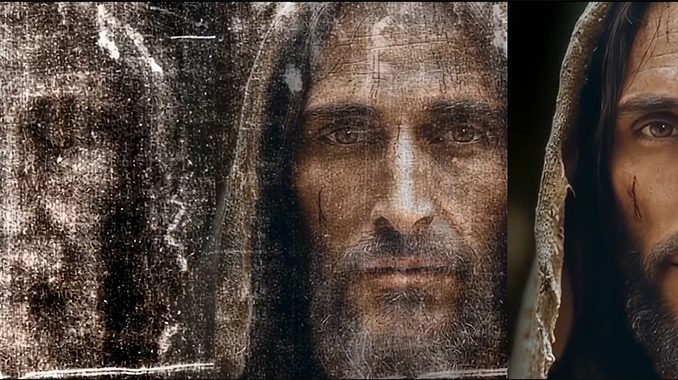
Christ Cathedral in Garden Grove, California, the chancery office of the Diocese of Orange, has welcomed a new interactive museum: “The Shroud of Turin: An Immersive Experience”. Located on the second floor of the campus’ Richard H. Pickup Cultural Center, the museum seeks to introduce visitors to the historic person Jesus of Nazareth. It offers visitors a better understanding of Christ’s crucifixion, death, burial, and resurrection by making use of the Shroud of Turin, which many believe to be the burial cloth of Christ.
The museum includes three interactive theaters, which introduce visitors to the historic Jesus and the Shroud, exhibits providing a detailed look at Christ’s sufferings and death, artwork and iconography of Christ, and presentations of the history and studies of the Shroud. While the museum seeks to persuade visitors that there is an abundance of evidence to demonstrate that the Shroud is authentic, more fundamentally, its purpose is to help those who come grow in their relationship with Christ and to accept His claims as to who He is.
Orange Auxiliary Bishop Timothy Freyer, who played a leading role in the effort to bring the museum to the Christ Cathedral grounds, explained, “I hope those who visit will come to believe more fully that Christ is truly risen, and that we no longer need to live in fear but in love.”
Developed by Othonia
Content for the 10,000 square foot, $5 million museum was developed by Othonia, a team of Shroud specialists. It will be open through at least 2030. Its founders hope it will be a prototype for Shroud museums in other parts of the country and throughout the world.
“The museum,” explains Nora Creech, who is on the leadership team of Othonia, “takes people on a journey to learn more about Jesus. We want them to look at the Shroud, and see what it tells us about Him.”
There has long been a debate as to the authenticity of the Shroud, Creech noted, “but the preponderance of evidence supports that it is. I don’t think we’ll ever have definitive proof; ultimately, it is a matter of faith.”
While the Shroud museum was created by Catholics and is housed on a Catholic chancery campus, Creech noted that the Shroud has drawn increasing attention in the non-Catholic Christian world, and specifically pointed to Dr. Jeremiah Johnston, who has promoted the Shroud in a variety of venues, including on the Tucker Carlson podcast. Creech said, “We want to overcome the perspective that it is just a ‘Catholic thing’. We believe it is the burial cloth of Christ, which is specifically mentioned in the Gospels.” (“Having bought a linen cloth, [Joseph of Arimathea] took [Jesus] down, wrapped him in the linen cloth and laid him in a tomb that had been hewn out of rock.”— Mk 15:46)
The museum is designed for people of all degrees of faith, she continued, and not only has a focus on Christ’s suffering and death, but His resurrection, “the foundation of the Christian church.”
Jason Pearson of FiveHive Studios is a Catholic convert who worked with Othonia to design the museum. His company offers special effects and animation services; the 81 Hollywood films he has worked on include Mel Gibson’s 2004 “The Passion of the Christ.” For the past seven years, he has also been a volunteer guide at the Shroud Center of Southern California, which is housed in the Santiago Retreat Center, also within the Diocese of Orange.
He noted that the three theater rooms use advanced technology that was incorporated in such educational exhibits as “Van Gogh Exhibition: The Immersive Experience” and the “Immersive King Tut.” The three theaters are at the beginning of the tour, and feature 360-projection, which is aimed at taking the viewer back to the historical scenes presented. The first theater introduces the Person of Christ through a dozen stories related in the Scripture, each picked to demonstrate the supernatural, such as the Transfiguration or Jesus walking on water. The second is a presentation of the science of the Shroud, and the third focuses on the resurrection of Christ, posing the question: Who do you believe the Man on the Shroud is?
“We’re doing things that have never been done before,” Pearson said. “The visitor sees the projection on the four walls surrounding him and on the floor, and is sitting in a room surrounded by sound; it’s like taking him back to the streets of Jerusalem in the first century and being part of the stories we relate.”
Exhibit area
The three theater rooms exit into an exhibit area. Exhibits include reproductions of the flagellum, or whip, used on Christ, as well as how His crown of thorns might have looked (styled like a helmet or cap, rather than a crown). There is a model of how Christ’s tomb might have looked, two rooms with an entry area, as well as where the body would have been laid.
Visitors are introduced to the Sudarium of Oviedo, the blood-stained facial burial cloth of Christ, which is kept in a cathedral in Spain, and how it relates to the Shroud.
Visitors can also see an exhibit showing the different markings on the Shroud which have come over the centuries, such as water stains and charred areas and burn holes, the result of a 1532 fire in Chambéry, France. There is an iconography exhibit demonstrating how the face of Christ has been portrayed through the centuries, demonstrating how remarkably similar it is to the face on the Shroud.
An AI exhibit introduces visitors to Secondo Pia (1855-1941), an Italian photographer who, while photographing the Shroud in 1898, discovered that the negative image of the Shroud gave a clearer image of the Man on the Shroud than the positive. Visitors can also “meet” Fr. Robert Spitzer, a Jesuit who has extensively studied the Shroud and frequently speaks on the compatibility of science and faith, who, in two kiosks, answers common questions visitors have about the Shroud. Fr. Spitzer’s office is located at Christ Cathedral, and he was on hand for the opening of the Shroud museum.
“I think the museum strikes a good balance between the science of the Shroud and the devotional aspect of coming to know Christ,” Fr. Spitzer said. “We expect it will have a positive impact on listeners, get their imaginations going, and demonstrate that the preponderance of evidence suggests the Shroud is authentic.”
“It’s also a great tool for evangelization,” he adds, “helping visitors to come to understand who Jesus Christ is.”
The tour concludes with a reflection room, which includes a full-size, backlit Shroud replica. It also features a life-size bronze sculpture by Italian artist Luigi Enzo Mattei depicting Jesus lying on His back the moment before His resurrection. It is a space, Creech said, “which gives visitors the opportunity to ponder the question: Who is the Man on the Shroud?”
Tickets are $10-20, children under 10 not admitted. Purchase tickets at www.theshroudexperience.com. School and group discounts are available.
If you value the news and views Catholic World Report provides, please consider donating to support our efforts. Your contribution will help us continue to make CWR available to all readers worldwide for free, without a subscription. Thank you for your generosity!
Click here for more information on donating to CWR. Click here to sign up for our newsletter.

I would love to come and visit the museum
Are there hotels nearby? Transportation?
There are several hotels within a couple of miles. Use Hotels.com or a similar site to search. And there are both bus and train lines that can be used to go the Cathedral grounds. The Exhibit’s site has more information on this page.
Attempts at technical artistic imaging of the original to date convey a marked difference unlike what one, at least this writer, experiences. Lost is the sense of absolute uniqueness and spiritual depth.
Perhaps it’s part of the mystery the original transmission from Christ to the shroud when resurrected. An inner conviction of supreme holiness.
About the very early (!) iconic imaging of Christ Pantocrator, the case is made that these bear a striking resemblance to the image of Christ on the Shroud, which was accessible in the earliest years (and therefore imitated?).
Identifying 15 distinctive facial features on the Shroud, Ian Wilson (“The Shroud of Turin: The Burial Cloth of Jesus Christ?,” Image, 1979) compared these features to facial icons from the 6th, 8th, 10th, 11th and 12th centuries. For the 11th-century icon at Daphini, he finds that only two markings are missing (the accentuated left and right cheeks). Accompanying a photo of the Shroud negative, he writes: “The cloth Byzantines called the ‘Mandylion’ disappeared in the thirteenth century. The cloth we call the ‘Shroud’ appeared in France in the fourteenth century. Could they have been one and the same thing?”
The Mandylion portrait is shown to be the Shroud folded and framed in such a way as to obscure all but the portrait. Wilson’s detailed history speculates that at the beginning, the recently-Jewish custodians of the burial cloth contrived the back-folded portrait as a way of preserving the whole cloth, but without displaying the full cloth–as possibly violating lingering scruples as unclean and as even a prohibited image in contrast with the Second Commandment (and in the early centuries, the Iconoclast Controversy).
As the new museum displays, a wealth of other historical and forensic information, and much more in later publications, also should turn a few heads (The Shroud of Turin Research Project (STURP); Wilson, “The Blood on the Shroud,” Touchstone, 1998; and the demonstrably inaccurate and later discredited Carbon-14 test from the late 1980s, etc.).
Creech and Spitzer refer to “the preponderance of evidence.” Good wording! The scientific method does not prove but also fails to disprove the authenticity of the Shroud. Even disbelieving members of the scientific community (their belief!) might now question their own unscientific predisposition against the Incarnation—the historical Person Jesus Christ who uniquely is “a matter of faith”.
On the Holy Shroud I see God’s noble rest (despite clear signs of suffering and torture), the Sabbath. I see Our Lord there, His humanity and divinity together. There is not a mere human, it is absolutely clear. The next to it “photo” or whatever shows a mere man, not Jesus at all. The more “photorealistic” it becomes, the shallower (spiritually) is the result.
The ultimate test for the truthfulness of the image of Our Lord is “Can I pray before it?” I can and do pray before the Face on the Shroud because I recognize My Lord there; I cannot pray before the image next to it because it is not Him.
I am convinced that only an image created by the hand of a person inspired/overtaken by God can serve as a true image of Our Lord which has “an imprint” of divinity (an icon). A true image of Jesus Christ is a result of a work = synergy of a soul and Christ. A mechanical “reconstruction” cannot do that. The Holy Spirit needs a human soul and body, not a computer, to communicate Himself.
Icons show the Face of Our Lord both now and in eternity. They achieve it via combining multiple points of view; this principle can be easily understood via the works of Paul Suzanne or cubists. As a result, the apple painted by Suzanne shows not just a particular apple – it shows “the appleness”, the materialization of an idea of an apple in the mind of God. It is never something temporary. Likewise, icons express an understanding of Who is depicted, the Revelation of God about Himself, and this is why they are both expressionistic and symbolic but never – photorealistic. They are realistic in a sense of truthfulness to the likeness of the prototype but they cannot be only realistic because they must convey metaphysical as well. This is why they also employ expressionism and symbolism to convey the presence of the divine.
If you like, icons express the knowledge, the visible and invisible together. Mechanical “photorealistic” reconstruction can convey the surface only and thus cannot really depict Our Lord. Intuitively, I find it very reassuring for our faith. Our Lord needs us – our relationship with Him – to reveal Himself.
14th century deepfake
21st century stupid comment.
I think the 14th century fraud theory was disproven.
Very much so. Long ago.