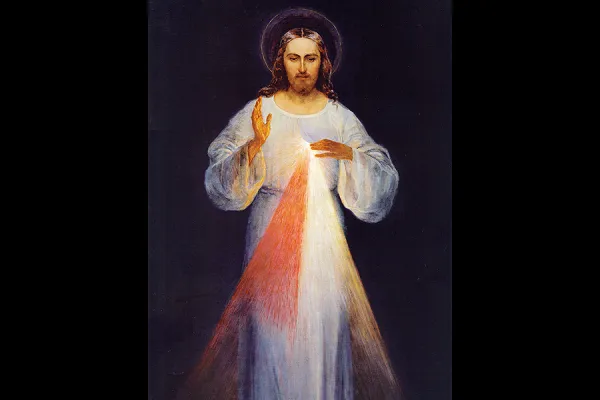
Vilnius, Lithuania, Apr 28, 2019 / 03:03 am (CNA).- Among Catholic devotions, the Divine Mercy message is well-known: the iconic image of Christ, with rays of red and white pouring from his heart; St. Faustina, called the “Apostle of Divine Mercy;” and the Basilica of Divine Mercy in Krakow, Poland.
But what you might not know is that more than 450 miles north of Krakow, in the Lithuanian capital Vilnius, there is another Sanctuary of Divine Mercy, one which houses the first image of the merciful Jesus created, and the only Image of Divine Mercy St. Faustina herself ever saw.
Archbishop Gintaras Grusas of Vilnius told CNA that the city, often called the “City of Mercy,” is not only “a place of the Divine Mercy revelations, but also a place that is in need of mercy, throughout history, and a place that in the last couple decades has been a place where we need to show mercy.”
Since long before St. Faustina and the Divine Mercy revelations, the Mother of Mercy has been the patroness of Vilnius, Grusas said.
In fact, in the 1600s, a painting of Our Lady of the Gate of Dawn was created and placed in a niche above one of the prominent city gates. Many miracles are attributed to the image, which was canonically crowned Mother of Mercy by Pope Pius XI in 1927.
It was in this small chapel of the Mother of Mercy, above the gate, that the Image of Divine Mercy was first displayed. So Vilnius has had “mercy upon mercy,” Grusas noted.
The story of St. Faustina and Divine Mercy
St. Faustina Kowalska was a young Polish nun born at the beginning of the 20th century. Over the course of several years she had visions of Jesus, whereby she was directed to create an image and to share with the world revelations of Jesus’ love and mercy.
St. Faustina received her first revelation of the merciful Jesus in Plock, Poland in February 1931. At the time, she had made her first vows as one of the Sisters of Our Lady of Mercy.
In 1933, after she made her perpetual vows, her superior directed her to move to the convent house in Vilnius. She stayed there for three years and this is where she received many more visions of Jesus. Vilnius is also where she found a priest to be her spiritual director, the now-Bl. Michael Sopocko.
With the help of Fr. Sopocko, St. Faustina found a painter to fulfill the request Jesus had made to her in one of the visions – to “paint an image according to the pattern you see, with the signature: Jesus, I trust in You” – and in 1934 the painter Eugene Kazimierowski created the original Divine Mercy painting under St. Faustina’s direction.
In its creation, St. Faustina “was instrumental in making all the adjustments with the painter,” Archbishop Grusas said.
The image shows Christ with his right hand raised as if giving a blessing, and the left touching his chest. Two rays, one pale, one red – which Jesus said are to signify water and blood – are descending from his heart.
St. Faustina recorded all of her visions and conversations with Jesus in her diary, called Divine Mercy in My Soul. Here she wrote the words of Jesus about the graces that would pour out on anyone who prayed before the image:
“I promise that the soul that will venerate this image will not perish. I also promise victory over [its] enemies already here on earth, especially at the hour of death. I Myself will defend [that soul] as My own glory.”
When the image was completed, it was first kept in the corridor of the convent of the Bernardine Sisters, which was beside the Church of St. Michael where Fr. Sopocko was rector.
In March 1936 St. Faustina became sick, with what is believed to have been tuberculosis, and was transferred back to Poland by her superiors. She died near Krakow in October 1938, at the age of 33.
“St. Faustina, because of her illness, was brought back to Krakow by her superiors. But she left the painting in Vilnius because it was the property of her spiritual director, who paid for the painting,” Grusas explained.
Jesus, in one of St. Faustina’s visions, had expressed his wish that the image be put in a place of honor, above the main altar of the church. And so, though St. Faustina had already returned to Poland, on the first Sunday after Easter in 1937, they hung the image of Merciful Jesus next to the main altar in the Church of St. Michael.
The history of the image
Archbishop Grusas explained that many people have only recently learned about the image because it was hidden for many years, and it was only rediscovered and restored within the last 15 years.
During World War II, Lithuania was under Soviet occupation and in 1948, the communist government closed the Church of St. Michael and abolished the convent. Many of the sacred objects and artworks were moved to another church to be saved from Soviet hands, but the Divine Mercy image was left undisturbed in St. Michael’s for several years.
In 1951, two women were able to pay the keeper of St. Michael’s church and save the image. Since it couldn’t be taken across the border to Poland, they gave it to the priest in charge of the Church of the Holy Spirit for safekeeping.
Five years later it was moved to a church in Belarus, where it remained for over a decade. In 1970 this church too was shut down by the government and looted, but miraculously, again the Image of Divine Mercy was untouched.
Eventually it was brought back to Lithuania in secret and again given to the Church of the Holy Spirit. In the early 2000s its significance was rediscovered and after a professional restoration it was rehung in the nearby Church of the Holy Trinity in 2005, which is now the Shrine of Divine Mercy.
So though it is a more recent arrival on the international scene, the painting “is also probably the most profound of the Divine Mercy paintings,” Grusas said. “It has a very deep theology, very closely tied with St. Faustina’s diary.”
The Shrine of Divine Mercy
Today in Vilnius the archdiocese has begun to set up a guide for pilgrims who come and wish to visit the holy sites, such as the place where St. Faustina lived, the room where the image was painted, and the several churches which all held the painting at different points.
The Shrine of Divine Mercy itself is not a large place, since it’s only a converted parish church, but its sacramental life “is really quite something,” said Justin Gough, an American seminarian studying in Rome who spent a summer working in the Archdiocese’s pilgrim office in Vilnius.
He said that “between Mass, the Divine Mercy chaplet every day in Lithuanian and Polish, adoration 24/7… vespers every Sunday night led by the youth of Vilnius,” the rosary and the sacrament of Confession, there is always some sort of prayer or sacrament taking place.
Of course the original Image of Divine Mercy is also there, he pointed out, and yet the shrine is not just about the image, but about connecting the image and what it represents to prayer and the reception of God’s mercy through the sacraments.
“I think it’s ironic in a certain sense that God teaches us about his mercy through a holy woman who died at the age of 33,” he said. “She lived a very devout life, endured great sufferings for the sake of Christ, and yet it’s through people like her that we’re taught, great sinners that we are, how to actually receive God’s mercy and to be merciful to others.”
In Vilnius, it’s a great blessing “to know a saint of the 20th century walked here, prayed here, and experienced Christ here, and that we can do that as well.”
This article was originally published on CNA Nov. 26, 2017.
 […]
[…]



Which “homosexuality” are they referring to? The sanitized for Western consumption, post-AIDS homosexuality where “gay marriage” is still largely “open marriage?” Or the inherently self-injurious “gay lifestyle” due to psychological and physical challenges to immunity (including substance abuse)even in the most accepting of cities, communities?
In the spirit of Aristotle will “gay awareness” include the actual facts/statistics?
Which one is a “misread” of Scripture?
Every single one of them should be pitched out of whatever offices they hold, and laicized, perhaps even excommunicated. And if I were the civil police I would be carefully investigating to see what crimes they have been committing that makes them want this evil legitimized.
Here is more evidence of the spread of the influence of Satan through sexuality. Homosexuality is a deviant sexual behavior along with Pedophilia and TransGenderism. We have already seen liberals calling for an “understanding” and acceptance of Pedophiles as simply another sexual orientation. They want to open the doors to public acceptance of child abuse. So far they have begun to make legal infanticide so it’s not that far a leap to child sexual abuse given the ease at which they have reduced a living human being to nothing more than a clump of cells even after birth. The evil of the past is showing it’s face and the destruction of the human soul starting with the most innocent has begun.
A synodal church to be.
In short, “We make these demands! Have a nice trip to Rome and say hi to the pope for us.”
What is Holy Mother Church in America doing about punishment for convicted child molesters? Celibacy is one of the vows a priest makes when receiving the Sacrament of Holy Orders. Obviously when a priest breaks his vow of celibacy he needs to speak with not only his bishop, to find out if he would be better suited as a married man; but, he also needs to speak with a licensed trained psychiatrist to help discover why he should remain a priest or live the rest of his life as a married Roman Catholic husband and future father of children. I’ve seen priests who were almost forced into the priesthood by parents who simply had to have one son who would be the priest of the family. Child molestation is another matter altogether. Convicted pedophiles should never be shuffled from parish to parish. These men are preditors and not merely men who made poor career choices. The Roman Catholic Church should never try to hide these men. Of course pedophiles require intensive therapy by trained psychiatrists. As an almost 68 year old Roman Catholic woman, I am ashamed that my beloved church has covered up for these men. I truly believe that the pedophilic priest must be defrocked and never, even as a Roman Catholic layman, be permitted to work with children as long as he lives. Permitting the pedophile to continue as a priest is wrong. He is a mentally disturbed person who needs help, of course. He is not a man to be trusted with the innocent child, ever again. The priest should always be able to be trusted by children and adults, especially those who have no one else to comfort them in their day to day life. I’ve always put my priests upon a pedistal because I realized, especially as I became an adult, they gave up married life, a wife and family, to deserve me calling him, with the greatest of love, “Father.” When I go to Confession and hear a priest encouraging me to empty my heart of troubles, as I say, “Bless me, Father, for I have sinned.”, I know that the holy and celibate priest, who deserves all my respect for all his sacrifices, knows how to help me make peace with God and he will absolve me of my transgressions. There is no room for convicted pedophiles in the priesthood of Holy Mother Church. He has stolen the innocence of a trusting and helpless child. He has murdered Innocense itself, as surely as those Roman soldiers tried to murder Baby Jesus while killing the Holy Innocents.
“Obviously when a priest breaks his vow of celibacy”
If I’m understanding correctly, “celibacy” means not marrying. So the problem with most of those priests is that they are not being chaste, as we are all called to be according to our states in life.
“he needs to speak with not only his bishop, to find out if he would be better suited as a married man;”
That should have been done before he was ordained. Added to which, something like 80% of the “pedophilia” cases were actually cases of homosexual assault on post-pubescent boys, which isn’t actually pedophilia.
“he also needs to speak with a licensed trained psychiatrist”
I wouldn’t trust a psychiatrist. Listening to psychiatrists’ advice was part of what led to moving abusers around; and the psychiatrists’ association also decided that homosexuality is not a mental disorder anymore, and that “transgenderism” is just fine.
“I’ve seen priests who were almost forced into the priesthood by parents who simply had to have one son who would be the priest of the family.”
Somehting which, again, should have been discovered during the discernment process, during their time in seminary – in short, *before* they were ordained. Why wasn’t it? How many priests was this that you’ve seen? When? How did you know that was why they became priests?
“poor career choices.” The priesthood isn’t a career, it’s a calling. Any man who thinks of it as a career shouldn’t be one.
The only absolute Dogma Cardinal Marx believes in is the Church Tax he and his cohorts extort from the Catholic Faithful in Germany.
More probing than spearhead. Prominent Catholic Black Ops Led by Fr Wucherpfennig openly homosexual rector mission to test enemy assets Cardinal Marx their Quisling [since it’s so ludicrously obvious I’m compelled to resort to humor however true]. As prev acknowledged the true enemy are advocates of normalizing the abomination of homosexuality posturing heroic aware as devious cowards they have Vatican and majority societal support. Quislings abound among German Hierarchy very few comparable to 1941 Hierarchy led by Augustus Cardinal von Galen. Although there are a few good men among them. With faith and God’s arm they can win the day. Even if vanquished by the morally disabled their strong resistance is in itself victory.
Open Letter to a group of Nine prominent German Catholics who want a new morality, women priests, etc. Your demands are not exactly a news bombshell. The Catholic faithful worldwide have been hearing this rubbish on and off for over 50 years. Your heretical gripes are getting old and boring. And there exists a fast solution to your unjust gripes: Leave the Roman Catholic Church and start your own church. It’s that simple. No sense sticking with the Church with over 2,000 years of constant teachings about morality and doctrinal beliefs when you Nine prominent German Catholics can start your own new-wave type of church. Frankly, I have more respect for the 16th century Protestant Reformers who left the Church instituted by Christ rather than sticking with it when they no longer believed in its core teachings. You have the full freedom to leave because no one is pointing a gun to your prominent heads, demanding your life or your consent. Parting advice: It is not psychologically sound to with an institution which you find abhorrent.