Vatican City, May 3, 2019 / 10:22 am (CNA).- Pope Francis Friday offered a critique of captialism’s impact on the environment, calling for a response that hears “the cry of the Earth and the cry of the poor.”
“The precarious condition of our common home has been the result largely of a fallacious economic model that has been followed for too long,” Pope Francis said May 3.
Francis called this economic model “profit-oriented, shortsighted, and based on the misconception of unlimited economic growth,” and said that it results in a “disastrous impact on the natural world.”
“Economic powers continue to justify the current global system where priority tends to be given to […] the pursuit of financial gain, which fail to take the context into account, let alone the effects on human dignity and the natural environment,” he said.
Pope Francis offered his reflection on the environment and the economy in an audience with the participants in the meeting, “Mining for the Common Good,” organized by the Vatican Dicastery for Promoting Integral Human Development.
Mining industry executives from Latin America, Africa, Asia, and Canada participated in the meeting, along with Anglican, Methodist, and Catholic leaders dedicated to development. The pope commended the participants for their commitment to dialogue.
“We need a paradigm shift in all our economic activities, including mining,” Pope Francis told the conference participants in the Apostolic Palace.
“Mining, like all economic activities, should be at the service of the entire human community,” he said.
Pope Francis stressed the importance of assessing the impact of mining projects on local communities.
Pointing to the upcoming Synod on the Amazon, he said that “it is essential to show special care for indigenous communities and their cultural traditions. They are not merely one minority among others, but should be the principal dialogue partners, especially when large projects affecting their land are proposed.”
“These vulnerable communities have a lot to teach us. For them, land is not a commodity but rather a gift from God and from their ancestors who rest there, a sacred space with which they need to interact if they are to maintain their identity and values,” Francis said.
The pope said that the effort and the struggle to protect the environment is “an ecumenical journey” that challenges “us to think and act as members of one common home.”
“Religious traditions have always presented temperance as a key component of responsible and ethical lifestyle,” he said. “Moderation is also vital to save our common home. ‘Blessed are the meek, for they shall inherit the earth.’”
If you value the news and views Catholic World Report provides, please consider donating to support our efforts. Your contribution will help us continue to make CWR available to all readers worldwide for free, without a subscription. Thank you for your generosity!
Click here for more information on donating to CWR. Click here to sign up for our newsletter.
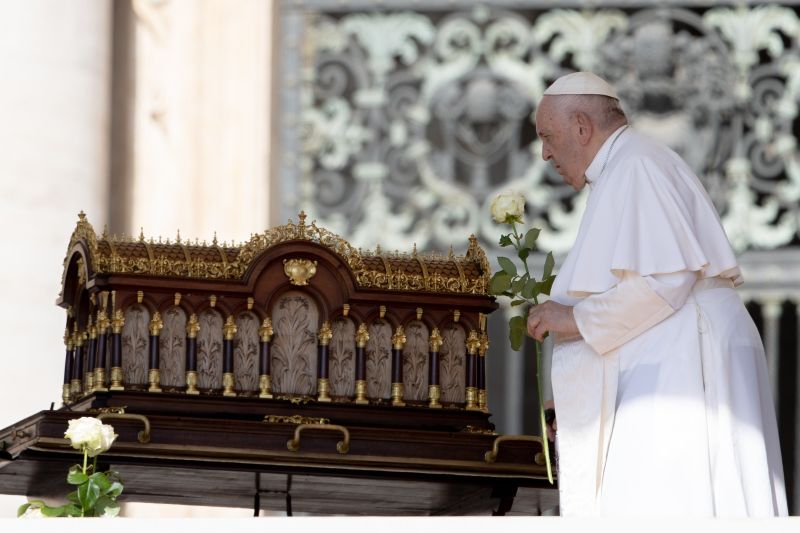
Pope Francis prayed before a relic of St. Therese of Lisieux at the beginning of his general audience in St. Peter’s Square, and shortly before going to the hospital for an abdominal surgery, on June 7, 2023. / Daniel Ibanez/CNA
Vatican City, Jun 7, 2023 / 04:37 am (CNA).
One of Pope Francis’ last gestures before undergoing abdominal surgery on Wednesday was to pray before a relic of St. Therese of Lisieux.
A relic of the French Carmelite nun, also known as St. Therese of the Child Jesus, was present on the platform in front of St. Peter’s Basilica during the pope’s weekly general audience June 7.
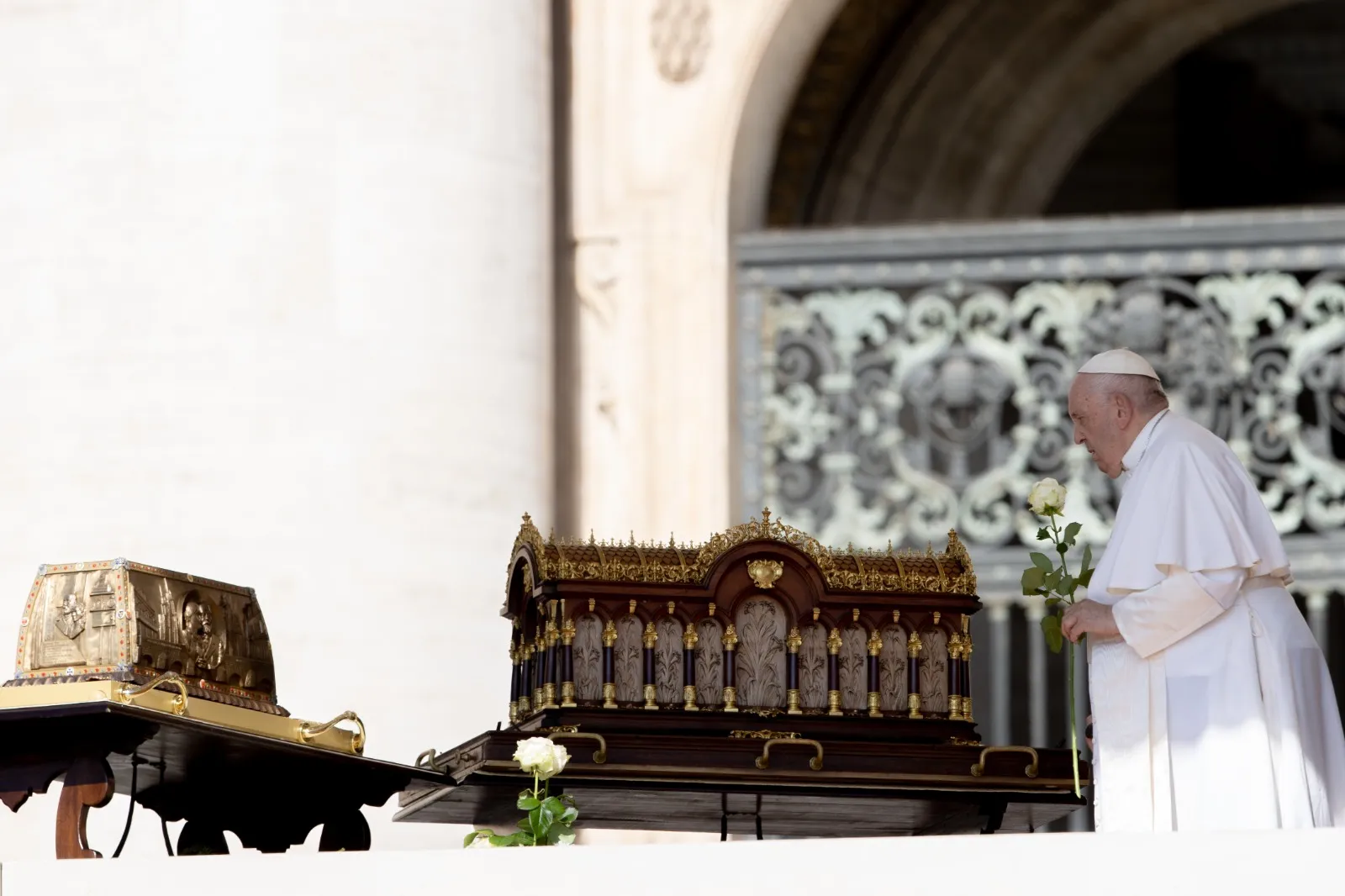
Before beginning the audience, Francis venerated the relics of St. Therese in a moment of silent prayer. He also placed a single, white rose on the table in front of the reliquary.
Pope Francis was taken to Rome’s Gemelli Hospital for abdominal surgery under general anesthesia at the end of the morning audience, shortly after 11:00 a.m. Rome time, the Vatican said.
Relics of St. Therese’s parents, Sts. Louis and Zélie Guérin Martin, were also present at the meeting with the public June 7. The relics of all three saints will visit different churches in Rome through June 16.
Relics of St. Therese of Lisieux and her parents, Sts. Louis and Zelie Guerin Martin, were on the platform in front of St. Peter’s Basilica during Pope Francis’ general audience June 7, 2023. The relics made a pilgrimage to Rome June 6-16, 2023. Daniel Ibanez/CNA
Pope Francis said Wednesday he intends to publish an apostolic letter on St. Therese of Lisieux, “patroness of the missions,” to mark the 150th anniversary of her birth.
“She was a Carmelite nun who lived her life according to the way of littleness and weakness: she defined herself as ‘a small grain of sand,’” he said in St. Peter’s Square.
“Having poor health, she died at the age of only 24,” he added. “But though her body was sickly, her heart was vibrant, missionary.”
“Here before us are the relics of St. Therese of the Child Jesus, universal patroness of missions,” he said. “It is good that this happens while we are reflecting on the passion for evangelization, on apostolic zeal. Today, then, let us allow the witness of St. Therese to help us. She was born 150 years ago, and I plan to dedicate an apostolic letter to her on this anniversary.”
🎥HIGHLIGHTS | Before commencing the General Audience in St. Peter’s Square, Pope Francis shared a beautiful moment of prayer before the sacred relics of St. Therese of Lisieux, Doctor of the Church and Patroness of the Missions. As a symbol of his devotion, the Holy Father… pic.twitter.com/lRJeWuSx8n
St. Therese of Lisieux was born on Jan. 2, 1873, in Alençon, France. Her mother died when she was four, leaving her father and older sisters to raise her. She received papal permission to enter the Carmelite Monastery at the young age of 15, where she lived until her death from Tuberculosis at the age of 24.
She was proclaimed a Doctor of the Church by St. Pope John Paul II in 1997 and is the patron saint of missions.
Pope Francis reflected on the saint’s life as part of a series of lessons on evangelical zeal.
“She is patroness of the missions, but she was never sent on mission,” Francis explained in his catechesis. “She recounts in her ‘diary’ that her desire was that of being a missionary, and that she wanted to be one not just for a few years, but for the rest of her life, even until the end of the world.”
St. Therese did this, he said, by becoming a spiritual sister to several missionaries, whom she accompanied through her prayers, letters, and sacrifices from within the monastery walls.
“Without being visible, she interceded for the missions, like an engine that, although hidden, gives a vehicle the power to move forward,” the pope said.
“Missionaries, in fact — of whom Therese is patroness — are not only those who travel long distances, learn new languages, do good works, and are good at proclamation,” he added. “No, a missionary is anyone who lives as an instrument of God’s love where they are.”
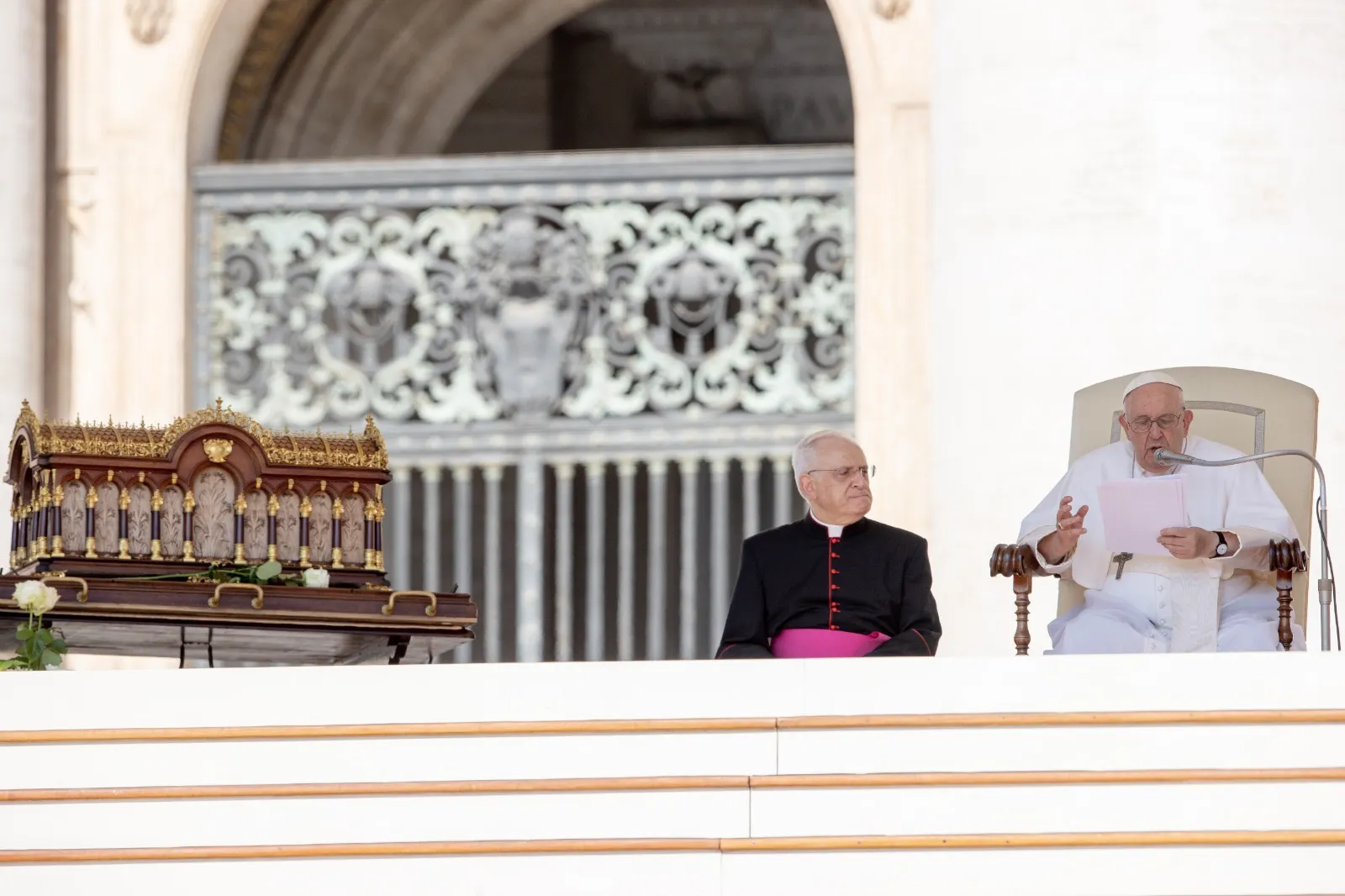
Pope Francis spoke about St. Therese of Lisieux, the patroness of missions, during his general audience June 7, 2023. Relics of St. Therese and her parents, Sts. Louis and Zelie Guerin Martin, were present on the platform beside the pope for the audience. Daniel Ibanez/CNA
Pope Francis recounted two episodes from St. Therese’s life that help to explain the source of her zeal and missionary strength.
The first happened during Christmas 1886, when Therese was almost 14 years old.
St. Therese was pampered as the youngest child of the family, he explained. But her father was tired after midnight Mass for Christmas and did not feel like being present when his daughter opened her gifts, so he said he was glad it was the last year she would receive gifts.
“Therese, who was very sensitive and easily moved to tears, was hurt, and went up to her room and cried,” the pope said.
“But she quickly suppressed her tears, went downstairs and, full of joy, she was the one who cheered her father,” he said. “What had happened? On that night, when Jesus had made himself weak out of love, her soul became strong: in just a few moments, she had come out of the prison of her selfishness and self-pity; she began to feel that ‘charity entered her heart’ — so she said — ‘with the need to forget herself’ (cf. Manuscript A, 133-134).”
“From then on, she directed her zeal toward others, that they might find God…”
The second event happened after St. Therese became a Carmelite. Pope Francis said the nun became aware of a hardened criminal, Enrico Pranzini, who was sentenced to death by guillotine for having murdered three people.
Therese had a special zeal for saving sinners, and so “she took him into her heart and did all she could: she prayed in every way for his conversion, so that he, whom, with brotherly compassion she called ‘poor wretched Pranzini,’ might demonstrate a small sign of repentance and make room for God’s mercy,” Francis said.
The day after his execution, she read in the newspaper that before laying his head on the chopping block, Pranzini had, “‘all of a sudden, seized by a sudden inspiration, turned around, grabbed a Crucifix that the priest handed to him and kissed three times the sacred wounds’ of Jesus,” he continued.
“Then his soul,” St. Therese wrote, “went to receive the merciful sentence of the One who declared that in Heaven there will be more joy for a single sinner who repents than for the ninety-nine righteous who have no need of repentance!”
Pope Francis said: “With so many means, methods, and structures available, which sometimes distract from what is essential, the Church needs hearts like Therese’s, hearts that draw people to love and bring people closer to God.”
“Let us today ask this saint, whose relics we have here,” he added, “let us ask this saint for the grace to overcome our selfishness and for the passion to intercede that Jesus might be known and loved.”
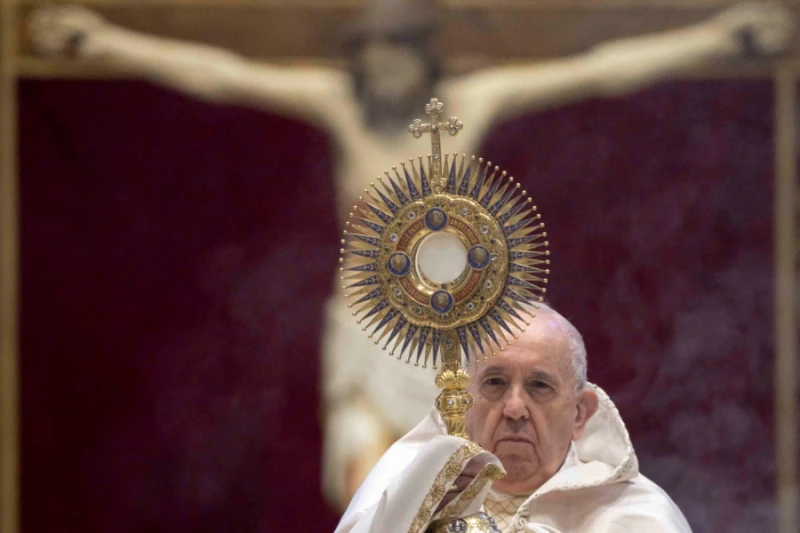
Eucharistic adoration following Pope Francis’ Corpus Christi Mass on June 14, 2020. / Vatican Media.
Vatican City, Oct 22, 2022 / 08:45 am (CNA).
It is good to “waste time adoring” Christ present in the Holy Eucharist, Pope Francis said on Saturday.
“I urge you to especially devote yourselves to the prayer of adoration — this is important,” he told a group of religious sisters at the Vatican Oct. 22.
“It is good to adore in silence before the Most Blessed Sacrament,” he said, “to be in the consoling presence of Jesus and there to draw the apostolic impetus to be instruments of goodness, tenderness and welcome in the community, the Church, and the world.”
Francis said the world today has lost the sense of what it means to engage in the form of prayer known as adoration or worship; “to waste time adoring.”
“This prayer is not often done: I ask you to do it. Adore, immerse yourself in divine love and give it with full hands to those you meet on your path,” he urged.
Pope Francis met Saturday religious women belonging to two communities: The Comboni Missionary Sisters and the Order of the Most Holy Savior, also known as the Bridgettines.
He said the sisters’ mission of hospitality is improved with time spent contemplating Christ.
“Welcoming, one of the characteristic aspects of your mission, will be more fruitful to the extent in which the prayer of contemplation will make you come out of yourself and focus your life on Jesus Christ, letting him do things in you, letting him act in you,” he said.
“This inner movement,” Francis added, “will make possible a service to others that is not philanthropy or welfarism, but openness to the other, closeness, sharing; in a word: charity.”
Vatican City, Apr 23, 2020 / 08:45 am (CNA).- Pope Francis marked the feast of his namesake on Thursday with a gift of ventilators and other medical equipment to countries with medical systems overwhelmed by the coronavirus outbreak.
“Religious traditions have always presented temperance as a key component of responsible and ethical lifestyle. Moderation is also vital to save our common home”. Pope Francis is quite correct. Although temperance and humble moderation spiritual virtues are not achieved in competitive world economies by simple admonition. If we continue to dilute the religious doctrine that underlies spiritual virtue, particularly with the proposed ecclesial construct of a super dicastery that marginalizes doctrine the Christian message will tend toward social egalitarianism. Our Church must first recover its religious substance rooted in that “religious tradition”. That followed by meaningful evangelization.



“Religious traditions have always presented temperance as a key component of responsible and ethical lifestyle. Moderation is also vital to save our common home”. Pope Francis is quite correct. Although temperance and humble moderation spiritual virtues are not achieved in competitive world economies by simple admonition. If we continue to dilute the religious doctrine that underlies spiritual virtue, particularly with the proposed ecclesial construct of a super dicastery that marginalizes doctrine the Christian message will tend toward social egalitarianism. Our Church must first recover its religious substance rooted in that “religious tradition”. That followed by meaningful evangelization.