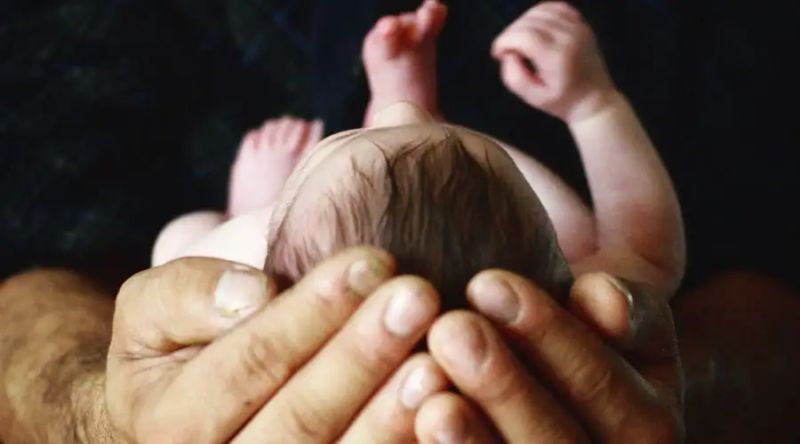
The Catholic bishops’ pro-life chair is applauding the passage of the Born-Alive Abortion Survivors Protection Act in the U.S. House of Representatives.
“We commend the House of Representatives for passing legislation to protect innocent children from infanticide and urge the Senate to follow suit,” Bishop Michael Burbidge of Arlington, Virginia, said in a statement Wednesday. “Babies who are born alive during the process of an abortion deserve compassionate care and medical attention — just the same as any other newborn baby.”
Members voted 220 to 210 on Wednesday to pass the act, also known as H.R. 26. All 210 who voted against it were Democrats. Only one Democrat voted “yes” to the bill: Rep. Henry Cuellar of Texas. Another Democrat, Rep. Vicente Gonzalez of Texas, voted “present.”
The act now goes to the Democrat-controlled Senate, where it is unlikely to advance.
Ahead of the House vote, Burbidge, the chair of the U.S. Conference of Catholic Bishops’ Committee for Pro-Life Activities, sent a letter to members of the House urging support for the bill. The act has the support of the U.S. Catholic bishops.
The Born-Alive Infants Protection Act of 2002, a law passed with bipartisan support, established that a “person,” “human being,” “child,” and “individual” includes infants born alive.
If you value the news and views Catholic World Report provides, please consider donating to support our efforts. Your contribution will help us continue to make CWR available to all readers worldwide for free, without a subscription. Thank you for your generosity!
Click here for more information on donating to CWR. Click here to sign up for our newsletter.
Ray Kapaun, the nephew of Servant of God Father Emil Kapaun, and his wife, Lee, at the Cathedral of the Immaculate Conception in Wichita, Kansas, on the day of Father Kapaun’s funeral. / Credit: Photo courtesy of Ray Kapaun
CNA Staff, Nov 11, 2024 / 06:00 am (CNA).
As a new film about U.S. military chaplains was released in theaters on Nov. 8, the nephew of heroic priest and chaplain Servant of God Father Emil Kapaun spoke about his uncle’s virtue and sense of mission during the Korean War.
“Fighting Spirit: A Combat Chaplain’s Journey” tells the story of former Army chaplain Justin Roberts as he travels to the funeral of Kapaun. Along the way, Roberts is inspired by the lives of the 419 other U.S. military chaplains who have given their lives in service. The documentary explores the stories of several of these chaplains, including the beloved Catholic priest.
Kapaun was a priest of the Diocese of Wichita, Kansas. Ordained on June 9, 1940, he began training in the U.S. Army Chaplain School at Fort Devens four years after his ordination. In January 1950, he was sent to Japan as a chaplain in the 8th Cavalry Regiment, 1st Cavalry Division. In July 1950, he was then sent to Korea, where he brought the sacraments to troops, tended to the injured, and prayed with soldiers in the foxholes. At times he celebrated Mass on the battlefield using the hood of a jeep as a makeshift altar.
Ray Kapaun receives the remains of his uncle, Father Emil Kapaun, and places them on the gurney to transport him out of the Defense POW/MIA Accounting Agency in Hawaii. Credit: Photo courtesy of Ray Kapaun
During the Battle of Unsan, Kapaun was captured along with other soldiers and taken to a Chinese-run prison camp in Pyoktong, North Korea. While there, he regularly stole food for his fellow prisoners and tended to their spiritual needs despite a prohibition on prayer.
After being taken to what prisoners called the “death house,” Kapaun died on May 23, 1951, after months of malnutrition and pneumonia.
His cause for sainthood is being promoted by the Diocese of Wichita and is currently being reviewed by the theological committee for the Dicastery for the Causes of Saints in Rome.
A nephew of the heroic priest, Ray Kapaun, told CNA that growing up he heard stories about his uncle from his grandmother. He recalled hearing about his uncle’s devotion to the Blessed Virgin Mary and how his vocation to the priesthood was clear from a young age: He would stack cardboard boxes on top of one another, throw a towel over them, and pretend to say Mass at his makeshift altar.
“He was the most unselfish person I think I’ve ever heard of,” Ray Kapaun said. “He just always put everybody else ahead of his own needs.”
One story that Ray remembers was told to him by his father. Shortly before Father Kapaun was about to head out to the Korean War, he went to visit his family in his hometown of Pilsen, Kansas. He pulled Ray’s father aside and told him: “I don’t think I’m going to be coming back from this one.”
“Dad was like, ‘No, don’t talk like that. You can’t,’” Ray recalled. “And he said, ‘I’m not telling you that to make you sad or feel sorry for me,’ he said, ‘I just have that feeling that I’m not coming back from this one.’”
Ray believes it was this feeling that allowed his uncle to “do the things he did to help the guys in the prison camp, to run out across the battlefield when bombs were exploding — he knew that is exactly where he needed to be and he did it with compassion, but he didn’t do it with fear. He did it with a knowing that God was going to take care of him and that was exactly where he needed to be.”
In March 2021, after 70 years, the skeletal remains of Father Kapaun were identified among 866 other unknown Korean soldiers buried at the National Memorial Cemetery of the Pacific in Honolulu. These remains were handed to American forces in 1954 by North Korea.
Ray said receiving the call that his uncle’s remains had been found was something he “never ever envisioned.” He called it truly “miraculous” that when Father Kapaun’s casket was opened for his body to be identified, “his [skeletal] remains were 98% intact.”
“They actually sent us a photo of the remains laid out as the skeleton and he was just missing a couple of fingertips, one of his toes, and the kneecap was all he was missing. So that in and of itself was pretty much a miracle” he said.
Father Kapaun’s funeral Mass was held on Sept. 29, 2021, at Wichita’s Hartman Arena, where over 5,000 people came together to remember him.
The entire Kapaun family at the dedication of the statue of Father Emil Kapaun in Pilsen, Kansas, on June 23, 2001. Credit: Photo courtesy of Ray Kapaun
In the days leading up to the funeral, Ray and his wife hosted two of the POWs (prisoners of war) who spent time with Father Kapaun in the prison camp and are the last two still alive.
Ray shared “an incredible moment” with the POWs: They were taken to the mortuary to have a moment alone with Father Kapaun and before entering, one of them, Col. Michael Dowe, turned to Ray and asked: “Am I going to get the chance to hold Father in my arms just one last time?”
“So, we had opened up the casket, and Mike is there, and he just starts crying and he was talking to Father and he’s like, ‘When they came to take you away we just didn’t stand up enough for you, we just didn’t stand up enough,’” Ray recalled.
“I know Father had his hands on his shoulders then as he did in the camp and I know he told him, ‘Oh, it’s OK Mike. You just gotta let me go. I’m where I wanted to be. So it’s OK,’” Ray said. “Those moments were probably the most memorable, the most touching for me.”
When asked how Father Kapaun can be a source of inspiration for not only chaplains but also for everyone, Ray said: “Father gives hope, and Father gives a meaning to find the right in the world, Father always looked for the good in the world.”
“I think especially now with all the division and all the hate and all the things going on in this world, he only saw the person. It wasn’t that you needed to be Catholic; he saw the person, he saw what their soul was and how they treated others.”
He added: “He saw the compassion that was needed, he saw somebody needed help and he would help them at whatever sacrifice to his own health.”
As for what he hopes people will take away from the new film about his uncle, Ray said he hopes people would “see others and not judge others” and that “you don’t have to do anything grandiose to do kind and great things in this world.”
People demonstrate, some holding Cuban flags, during a protest against the Cuban government at Versailles Restaurant in Miami, on July 12, 2021. – Havana on Monday blamed a US “policy of economic suffocation” for unprecedented protests against Cuba’s communist government as Washington pointed the finger at “decades of repression” in the one-party state. Credit: Eva Marie Uzcategui/AFP via Getty Images.
Denver Newsroom, Jul 13, 2021 / 20:01 pm (CNA).
Four Cuban-American bishops issued a statement Tuesday indicating their support for Cubans seeking recognition of their human rights, following protest’s of the island’s communist government.
“We, Cuban-American bishops, join in solidarity with the Cuban people in their quest for responses to their human rights and needs. We are deeply troubled by the aggressive reaction of the government to the peaceful manifestations, recognizing that ‘violence engenders violence,’” read the July 13 statement.
“Such a reaction seems to negate the basic Cuban principle of having ‘una patria con todos y para el bien de todos’ (a homeland with all and for the good of all). We stand in solidarity with those detained because they have voiced their opinions.”
The statement was signed by Archbishop Nelson Perez of Philadelphia; Bishop Felipe Estevez of St. Augustine; Bishop Manuel Cruz, Auxiliary Bishop of Newark; and Bishop Octavio Cisneros, Auxiliary Bishop Emeritus of Brooklyn.
Archbishop Perez was born in Miami to Cuban emigrants, while Bishops Estevez, Cruz, and Cisneros were all born in Cuba.
Protests took place across Cuba July 11-12. Protesters cited concerns about inflation, shortages of food and medicine, and the Covid-19 pandemic.
Some protesters were beaten, and at least 100 were arrested. Among the arrested was Father Castor Álvarez, a priest of the Archdiocese of Camagüey.
The Cuban-American bishops said the protesters’ “chant of ‘Libertad’ underscores their desire for every Cuban citizen to enjoy basic human rights, as recognized as part of our human dignity by the United Nations, and defended for centuries by the Catholic Church in its social teaching.”
“As Cubans and as bishops of the Catholic Church in the United States, we are ever-mindful of the constant suffering and frustration of our brothers and sisters on the Island. We recognize that, while hundreds of thousands have experienced the need to emigrate, in order to enjoy basic human rights and a future filled with possibilities, those who have not – by choice or inability to do so – as Cubans in Cuba, are to be the actors of their own future and aspirations. The right and courage of the people in Cuba to raise their voice publicly, casting away their fear of repression and revealing authentic solidarity as a people, are acknowledged and applauded.”
The bishops called on “governments and all charitable organizations to collaborate in assisting in this urgent humanitarian crisis for the sake of the suffering people of Cuba, especially the sick and the poor. We commend the care of Caritas Cubana, as it continues to mediate – with ever so limited resources – a response to the basic human needs of the people of the Island.”
“As always, together with our brother-bishops in Cuba, and our brothers and sisters inside and outside the Island. We continue to place our trust in the motherly gaze of the patroness of Cuba, Our Lady of Charity,” they concluded.
Communist rule in Cuba was established soon after the conclusion of the Cuban Revolution in 1959, which ousted the authoritarian ruler Fulgencio Batista.
A statue of Our Lady of Mount Carmel was carried in procession in Rome’s Trastevere neighborhood on July 24, 2022. / Daniel Ibáñez/CNA
Rome Newsroom, Jul 26, 2022 / 08:17 am (CNA).
Rome’s nine-day celebration of Our Lady of Mount Carmel culmina… […]
1 Comment
Well, nearly half of the House protests in favor of infanticide. Not really “infanticide,” but “freedom of choice” no matter what, nor whom…
Alice was not the only one in Wonderland: “Must a name mean something?” Alice asks Humpty Dumpty, only to get this answer: “When I use a word…it means just what I choose it to mean – neither more nor less.”
Well, nearly half of the House protests in favor of infanticide. Not really “infanticide,” but “freedom of choice” no matter what, nor whom…
Alice was not the only one in Wonderland: “Must a name mean something?” Alice asks Humpty Dumpty, only to get this answer: “When I use a word…it means just what I choose it to mean – neither more nor less.”
